
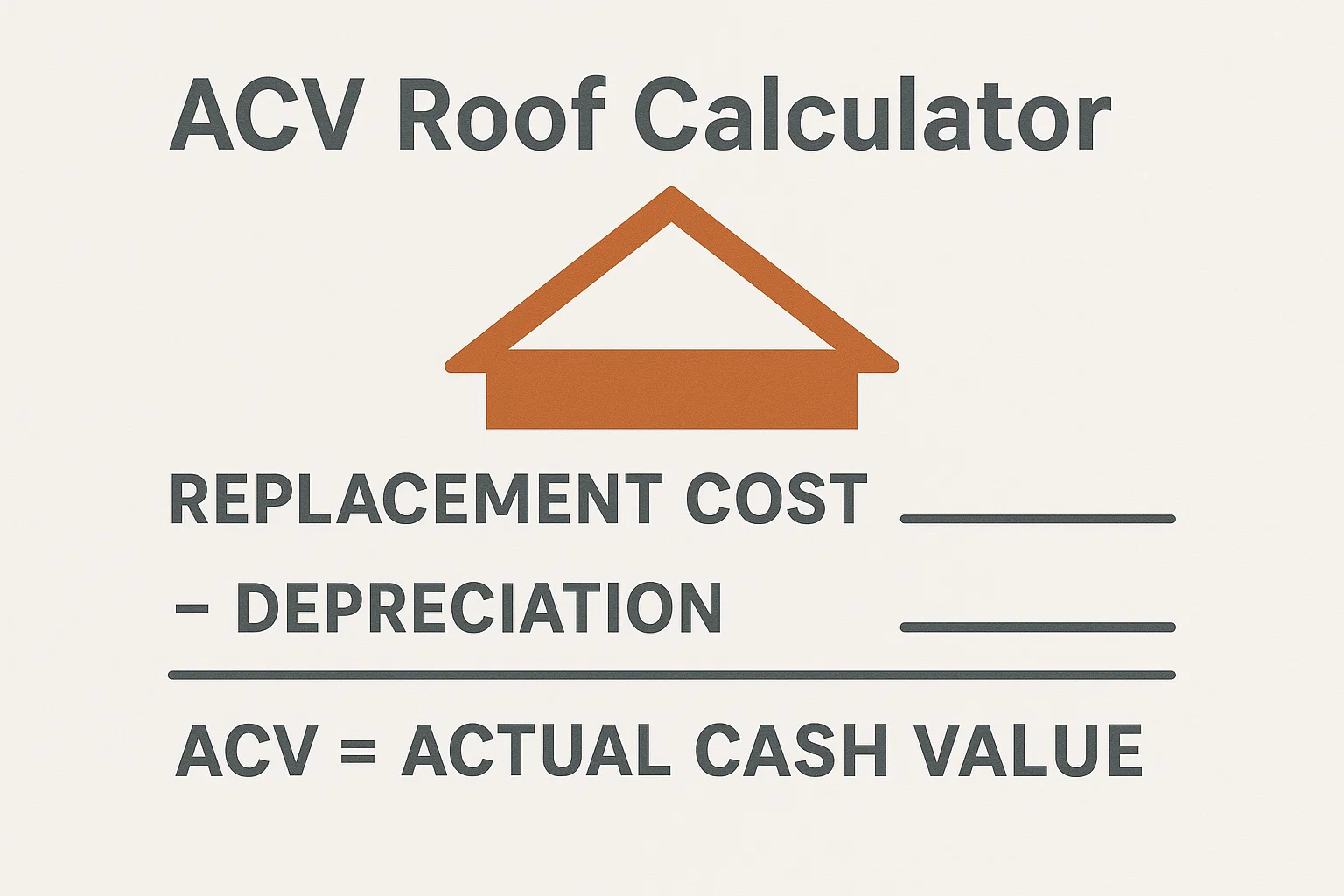
Here is the short version of this ACV vs. RCV Texas guide: roof insurance pays either what a new roof costs today or a smaller, depreciated amount, and your policy decides which. Replacement cost value (RCV) is the first kind of coverage. Actual cash value (ACV) is the second.
The difference rarely matters until a storm damages the roof. Then it can decide whether you pay only your deductible or a large share of the new roof yourself. This page walks through the terms, the math and the questions to ask, using what the Texas Department of Insurance (TDI) publishes for homeowners.
5 Terms You Will See on a Roof Claim
Insurance paperwork reuses the same handful of words. Learn these five and a claim letter gets much easier to read.
- Replacement cost value (RCV): what it would cost at today's prices to repair or replace the damaged roof.
- Actual cash value (ACV): the replacement cost minus depreciation.
- Depreciation: the value a roof has lost to age and wear, as your insurer calculates it.
- Recoverable depreciation: the depreciation a replacement cost policy holds back at first and pays once the work is done.
- Deductible: the part of each claim you pay yourself before the policy pays anything.
TDI's home insurance guide covers the same ground, and its advice is direct: to be fully protected, make sure your policy has replacement cost coverage.
Actual Cash Value vs Replacement Cost: The Core Difference
Both settlements start from the same number: the adjuster's estimate of what the repair or replacement costs at current prices. A replacement cost policy pays that estimate, less your deductible, whether the roof is two years old or twenty. An actual cash value policy subtracts depreciation first and the deductible second.
That is why the gap between the two grows as a roof ages. On a young roof the two payments can be close. On an old roof, depreciation can take most of the estimate. In TDI's own worked example, the oldest roof's depreciated value is used up entirely by the deductible, so the ACV policy pays nothing toward the new roof.
TDI also spells out the trade-off. Policies with actual cash value coverage cost less, but they pay less when you have a claim. Neither choice is right for every household. The real question is how much of a roof you could pay for on your own after a storm.
How Depreciation Is Figured on an ACV Roof
TDI defines depreciation as a decrease in value because of wear and age. Your insurer calculates it, not your roofer, and each company uses its own method. Age is the biggest factor, but condition counts too. Missing granules, curled shingles and old patches make a roof look more worn than its age alone suggests.
The type of roof matters because some materials simply last longer. These are the service lives we plan around on the Coastal Bend:
- 3-tab shingles: 12 to 18 years
- Architectural shingles, such as Owens Corning Duration: 25 to 30 years
- Impact-resistant (Class 4) shingles: 30 years or more
- Standing seam metal: 50 to 70 years
- DECRA stone-coated steel: 50 years or more
So two roofs of the same age can carry very different depreciation. A 12-year-old 3-tab roof is close to the end of its life, while a 12-year-old metal roof has decades left. For a rough idea of your own number, try our roof depreciation calculator or the ACV roof calculator. Your insurer's figure is still the one that counts.
Depreciation also explains why two neighbors with the same storm damage can end up with very different checks. If one roof is three years old and the other is fifteen, a replacement cost policy would eventually pay both close to the full estimate. An actual cash value policy would pay the older roof far less, and the owner would make up the difference.
What an RCV Roof Policy Pays, and When
Replacement cost coverage usually does not arrive as one check. TDI explains that most companies pay it in two parts. The first check comes after the adjuster looks at the damage, and it equals the estimated repair cost minus depreciation and minus your deductible.
The held-back depreciation is the second check. According to TDI, the company pays it after it gets the bill for the finished job, and you usually must complete repairs within a certain period of time. That window is set by your policy, so ask your agent or adjuster for it in writing as soon as the claim opens.
This is what recoverable depreciation means in practice. It is real money, but only if the roof is replaced on time and the paperwork reaches the insurer. Keep the signed contract, the final invoice, proof that you paid the deductible and photos of the finished roof in one place. TDI notes that an insurer can ask for proof of the deductible payment before it pays the full amount of a claim.
If you still owe money on the house, TDI says the check is usually made out to both you and your mortgage company. The lender then releases the money as the work moves along, so build that step into your timeline.
When an ACV Roof Policy Leaves You Short
Under actual cash value, depreciation is gone for good. There is no second check, so the first payment is the whole settlement. The difference between that payment and the price of the new roof is yours to cover, on top of the deductible.
Many homeowners never pick ACV on purpose; it shows up at renewal. TDI warns that as roofs age, some companies switch roof coverage to actual cash value, and a roof in poor condition may not be covered at all. Your company should tell you when it changes your coverage, but that notice can be a single line in a renewal packet.
If your insurer has already said the roof must be replaced before it will renew, read our guide on insurance requiring a roof replacement. For a broader look at which kinds of damage a policy pays for, see does insurance cover roof replacement. And if a settlement leaves a gap you cannot cover in cash, financing through Acorn Finance, a third-party lender, is available for qualified homeowners; details are on our roof financing page.
How the Deductible Changes Both Settlements
The deductible comes off under either type of policy. TDI explains that it may be a set dollar amount or a percentage of the home's insured value, and a percentage deductible can be bigger than it sounds. It applies to each claim, not once a year.
On the coast, ask whether your wind and hail deductible is different from the one for other kinds of damage. TDI notes that if it is, a storm claim could cost you more out of pocket. A higher deductible generally lowers what you pay for the policy, so the right level depends on what you could afford after a storm.
One rule never bends: in Texas it is illegal for a contractor to waive your deductible or rebate it back to you. TDI's page on contractors and deductibles explains why that offer is a red flag.
Two Policies on the Coast, Two Sets of Terms
TDI points out that if you live on the Texas coast, your home policy might not cover wind and hail damage. Homeowners in that position buy wind and hail coverage from the Texas Windstorm Insurance Association (TWIA) through a local agent, while fire, theft and other losses stay with the regular home policy.
That means one house can have two policies with two different answers on ACV and RCV. The home policy might pay replacement cost while the wind policy settles the roof at actual cash value, or the other way around. Read the declarations page of each one; TDI describes it as the summary of your coverages, dollar limits and deductibles.
TDI also notes that most companies require you to insure the house for at least a minimum share of its replacement cost, and some require the full amount. Rebuilding costs rise, so ask your agent at renewal whether your limit still meets the company's rule. Our Texas windstorm insurance guide covers TWIA and the WPI-8 certificate in more depth.
Texas Claim Deadlines for Either Kind of Policy
Whatever the settlement basis, Texas law sets deadlines once you file. According to TDI's home insurance guide, your insurance company must:
- Tell you it received your claim within 15 days.
- Accept or deny the claim within 15 business days after it has all the information it needs from you. A company that needs more time can take up to 45 days if it tells you why, and deadlines may be longer after major disasters.
- Send payment within five business days after it agrees to pay.
TWIA runs on its own clock. TDI says TWIA has 60 days to accept or deny a claim and 10 days to pay once it has accepted, and you have one year from the date of damage to file a TWIA claim.
If a company denies the claim, TDI says it must explain why in writing. If you think the depreciation or the estimate is wrong, TDI's first advice is to tell the insurance company why. When that doesn't settle it, TDI describes an appraisal process for disputes about how much a claim is worth, though not about whether the policy covers it, and you can file a written complaint with TDI.
ACV vs RCV Texas Guide: Roof Insurance Checklist for Renewal
Pull out your declarations pages before hurricane season and work through these questions with your agent:
- Is my roof covered at replacement cost or actual cash value on each policy I carry?
- Will that change as the roof ages, and how will I be told?
- Is my wind and hail deductible a dollar amount or a percentage, and what is it in dollars?
- Does my dwelling limit still meet the company's minimum share of replacement cost?
- After a loss, how long do I have to finish repairs and collect any held-back depreciation?
TDI's page on insurance and your roof adds one more point to remember: an insurance company won't pay for a new roof just because the old one is old or worn out. Claims are for damage from a storm, a falling tree or another covered event.
How We Fit Into an ACV or RCV Roof Claim
Our part starts with a free inspection. We photograph the roof, sending up a drone when it is steep or tall, and give you a written report you can send your insurance company along with your claim. Whether the roof is paid at ACV or RCV, and how much depreciation applies, is your insurer's decision, and the adjuster's estimate sets the scope of work.
Once a replacement is approved, you get a written quote with a locked price, usually 24 to 48 hours after the inspection. If tear-off exposes damage the approved scope did not include, we document it and submit a supplement with photos to your insurer for review. Rotten decking, if we find any, is a per-sheet charge outside the signed price. When the job is done, you receive the final invoice, the bill most insurers wait for before they release held-back depreciation.
Inside the windstorm area we tear off to the deck, pull the city permit and handle the TDI windstorm inspections that lead to a WPI-8. Every replacement carries our 10-year workmanship warranty. To get photos and a report on your roof, book a free roof inspection, or read our step-by-step guide to the roof insurance claim process.
Frequently Asked Questions
RCV pays what it costs today to repair or replace the damaged roof, less your deductible. ACV subtracts depreciation for the roof's age and wear first, so it pays less, and the gap is widest on an older roof.
Usually, yes. TDI says most companies hold the depreciation back from the first check and pay it after they receive the bill for the finished job. Your policy sets a deadline for finishing repairs, so ask your agent or adjuster for it.
Yes. TDI notes that some companies switch roof coverage to actual cash value as roofs age, and may not cover a roof in poor condition at all. The company should tell you when it changes your coverage, so read every renewal notice.
No. Your insurer calculates depreciation and decides coverage, and the adjuster's estimate sets the scope. We provide photos and a written report on the roof's condition that you can send to your insurer.