Tile, shake and shingle looks in steel, from a certified DECRA and Tilcor installer who brings samples to your home.
Stone coated steel roofing gives a house the look of clay tile, wood shake or architectural shingles, with steel underneath. RISE Roofing is a certified DECRA and Tilcor installer. We install every profile both brands make, and we bring samples to your home at the free consultation.
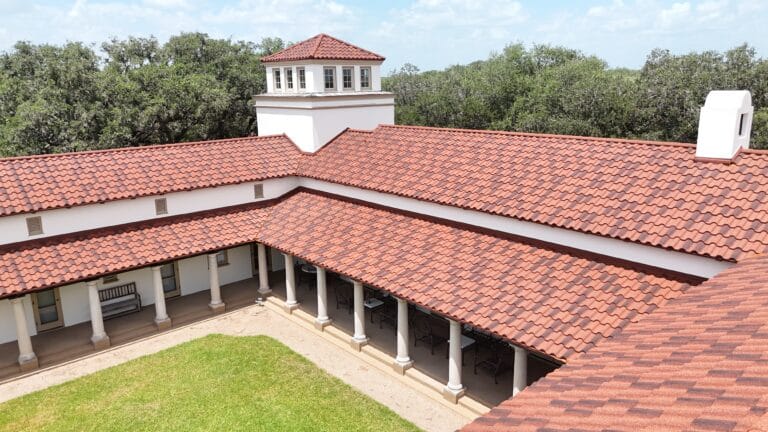
This page covers how the panels are made, the tile, shake and shingle profiles, the two ways we fasten them, when a tear-off is required, DECRA's warranty in plain terms, and what a stone-coated roof costs.
Each panel starts as a sheet of steel with a metallic coating that protects it from rust. The sheet is pressed into the shape of several tiles, shakes or shingles at once, then covered with a bonding coat and crushed stone granules that give it color and texture.
From the street, a finished roof reads like the material it copies. The difference is underneath: steel weighs far less than clay or concrete tile, and it does not split, curl or rot the way wood shake can. Because the color comes from the stone granules, the finish has a matte, textured look instead of the sheen of painted metal.
The panels lock into one another along their edges and overlap the course below, so a roof goes on in rows from the eaves up to the ridge. Trim pieces in the same finish cover the ridge, hips, rakes and the edges around walls and chimneys.
DECRA and Tilcor are both owned by IKO, which bought DECRA in 2018 and Tilcor in 2021. IKO makes both lines at its plant in Ennis, Texas, and DECRA's ICC-ES code reports also list a plant in Corona, California.
We are certified by both brands, and our certified crew has installed DECRA for more than 20 years. Because we install both full lines, you can set a DECRA profile next to a Tilcor profile and choose on looks and warranty terms, not on what one contractor happens to stock.
If you love the look of a tile roof, three stone-coated profiles are worth comparing:
Real clay and concrete tile are heavy, and a house framed for shingles may need its structure checked or strengthened before it can carry them. Steel tile panels are much lighter, though it is still worth having the framing looked at before any tile-style roof goes on. DECRA shows both of its tile profiles on its metal tile roofing page, and our clay tile roofing page covers the real thing.
A DECRA roof we installed was named a 2025 DECRA Project of the Year finalist. It is a Villa Tile roof in the Rustico Clay color, on a ranch.
For a wood or shingle look, the two brands offer several profiles:
Shake profiles suit Craftsman and ranch-style houses, while the shingle profiles suit owners who want a roof that blends in with the rest of the street. Color matters as much as profile, so we bring samples you can hold against your brick, stone or siding in your own daylight.
If you are weighing stone coated steel roofing, these are the three roofs it is usually compared with:
If the look of tile or shake matters to you, or to your HOA, stone-coated steel is the metal roof that delivers it. We supply product sheets and color samples for a design review, and you submit the application.
Stone-coated steel can be fastened straight to the roof deck or to a grid of wood strips called battens. We install both ways, and most of our shake and shingle roofs go direct to deck. We also install Tilcor Antica direct to deck.
Which method a given profile allows comes from its maker's installation instructions, and we follow them for every roof. Battens leave a small air space between the panels and the deck. Either way, the panels go over new underlayment, with flashing made for the new roof at walls, chimneys, valleys and vents.
DECRA's code report allows its panels to go over an existing shingle roof, which saves the cost of tearing off. We do that only for homes outside the Texas windstorm (TWIA) area.
Inside the windstorm area, which takes in all of Nueces County along with the other coastal counties, we tear off the old roof first. That lets us replace rotten decking and start with new underlayment. Most roof replacements in this area are inspected during the work, and the Texas Department of Insurance issues a WPI-8 certificate when the work complies; TWIA coverage generally depends on it. We schedule those inspections and pull the permits. Our Texas windstorm guide walks through the process.
DECRA calls its warranty on a single-family home a Lifetime Limited warranty. In plain terms:
That is a manufacturer warranty, not a workmanship warranty, which is one reason to have a DECRA roof put on by a crew DECRA has certified. Tilcor publishes its own warranty terms, so ask us for the current document if you are leaning toward a Tilcor profile.
DECRA says its stone-coated steel profiles earn the Class 4 impact rating from Underwriters Laboratories, the highest class in that test; see decra.com. Steel can dent in very large hail, but it does not crack the way clay or concrete tile can.
That rating can matter for insurance. TDI explains that each insurer sets its own roof credits and that a Class 4 roof covering receives the highest premium credit. For TWIA's credit, the product must be tested to UL 2218, labeled, and documented on TDI form PC068. Ask your insurance agent what your policy offers before you choose.
Every stone-coated roof we install is engineered for local wind loads and fastened to the windstorm requirements for your address. If you live near salt water, read the written DECRA or Tilcor warranty for any terms that apply to coastal homes before you settle on a profile.
DECRA stone-coated steel costs $12 to $16 per square foot of roof, installed. Two worked examples:
Our quotes include tear-off and disposal, new underlayment, drip edge, new flashing, ridge ventilation and full cleanup; an over-shingle job outside the windstorm area skips the tear-off. Rotten decking found after tear-off is priced per sheet, outside the signed price. Tilcor profiles are quoted job by job.
The written quote usually arrives within 24 to 48 hours. It holds for about 15 days, and the price locks when you sign. Financing is available through Acorn Finance, a third-party lender, for qualified homeowners; see our roof financing page.
We give homeowners a lifespan of 50+ years for DECRA stone-coated steel. That puts it with standing seam, which we expect to last 50 to 70 years, and well past the 25 to 30 years we give architectural shingles. Across that many years, flashing details and pipe boots are what tend to need a roofer's attention, rather than the steel panels. Our metal roof lifespan chart lists every system we install.
If you want metal but prefer clean vertical lines to a tile or shake look, see our standing seam roofing page.
A stone-coated roof asks for very little. Keep valleys and gutters clear so water drains freely, and trim branches that rub the roof, since scraping wears the stone surface. Skip pressure washing, which can strip granules. After a hurricane or a hard hailstorm, have the flashing, ridge and any lifted panels checked. Our roof maintenance plans cover a scheduled inspection with photos and small fixes; ask us for the details.
We bring DECRA and Tilcor samples to your home so you can see the profiles and colors against the house itself. We inspect the roof, using a drone on steep or tall roofs, and confirm whether your address is inside the windstorm area, which decides between an over-shingle install and a tear-off.
Questions worth asking any stone-coated installer:
If you have your heart set on DECRA specifically, our DECRA roofing page goes into that brand in more depth.
DECRA's code report allows it, and we do it for homes outside the Texas windstorm (TWIA) area. Inside that area, which includes all of Nueces County, we tear off the old roof first.
On a single-family home it is a Lifetime Limited warranty for the homeowner's lifetime. Labor and materials for a component with a manufacturing defect are covered during the first 20 years. It transfers once within 20 years, excludes damage from improper installation and does not guarantee replacement panels will be available.
DECRA Villa Tile, which copies barrel-style Spanish tile, is our top-selling profile. A Villa Tile roof we put on was a 2025 DECRA Project of the Year finalist.
DECRA runs $12 to $16 per square foot installed, or $24,000 to $32,000 for a 2,000-square-foot roof. Rotten decking found after tear-off is priced per sheet, outside the signed price.
They are sister brands. IKO owns both and makes them at its plant in Ennis, Texas. We are a certified installer for both.
Product details available at decra.com.
No waiting around for multiple contractors to come bid your roof. One quick call is all it takes.
Pick any slot that works for you — online and instant.
Free video or voice call. We answer your questions and gather what we need.
We email your price-locked quote — no pressure, no sales visit.
🔒 Free, no-obligation quote — Price-locked estimate in 24–48 hrs
Trace your roof on satellite imagery and get a real installed price in under 60 seconds.
Powered by satellite roof measurement technology. No obligation.