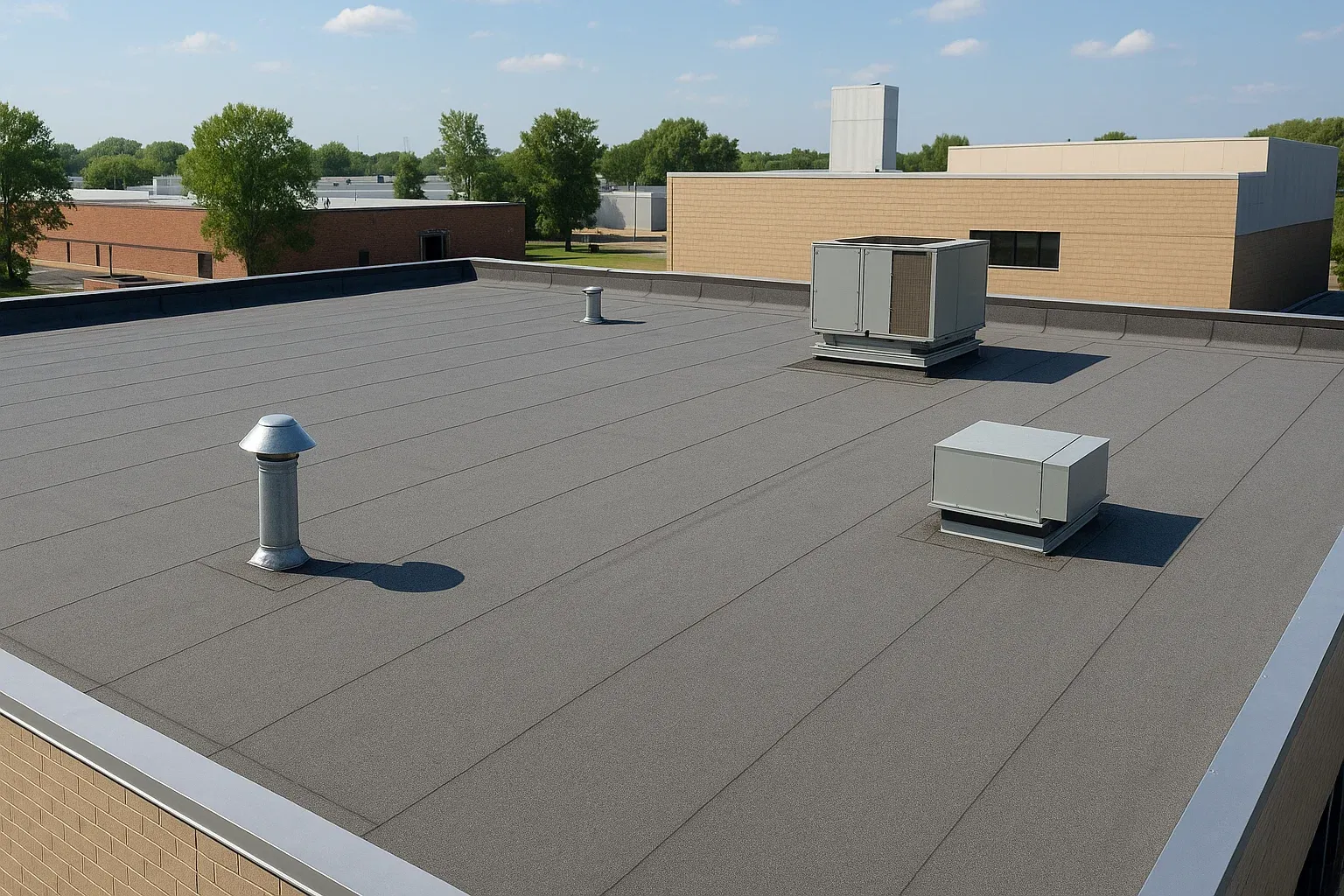
For flat and low-slope commercial roofs, modified bitumen roofing offers a time-tested solution that combines the reliability of built-up roofing with modern materials and ease of installation. RISE Roofing is skilled in installing and maintaining modified bitumen (mod-bit) roofing systems. We adopt the same formal, trustworthy approach to mod-bit as we do with all our services: educating our clients, emphasizing quality, and tailoring solutions to their needs. In this section, we’ll explain what modified bitumen roofing is, its benefits, and ideal uses. We’ll also detail why RISE Roofing is an excellent choice for businesses considering this durable roofing option.


Modified bitumen roofing is a type of asphalt-based roofing for low-slope roofs that has been “modified” with polymers to improve performance:
Traditional built-up roofing (BUR) uses layers of asphalt and felt. Modified bitumen takes asphalt (bitumen) and blends it with rubber or plastic polymers. The two main types are SBS (styrene-butadiene-styrene) which gives the asphalt a rubberized quality (making it flexible, like a rubber), and APP (atactic polypropylene) which gives it plastic-like qualities (improving UV resistance, for example). These modified asphalts are formed into rolls of roofing membrane, often with a reinforcing mat (fiberglass or polyester) for strength.
Modified bitumen membranes typically come in rolls (usually 3 feet wide) and are meant to be installed in multiple layers. A common assembly is a 2-ply system: a base sheet and a cap sheet. The cap sheet usually has mineral granules on top (like the granules on shingles) or a foil laminate to provide UV protection and durability. The base sheet might be smooth or sanded. Sometimes, more layers are used for extra durability (3-4 ply), often in combination with traditional BUR layers.
APP mod-bit is often applied with a torch. The bottom of the sheet has a bitumen layer that’s melted with a propane torch as the roll is unrolled, fusing it to the substrate or to the underlying sheet. This method requires skill and safety precautions (open flame on the roof).
Uses special adhesives (asphaltic cements or mastics) to glue the sheets down instead of torching. This avoids the fire hazard and fumes of torching, although curing times for adhesive and weather conditions need consideration.
Some mod-bit sheets come with a peel-and-stick backing. The installer just removes a release film and sticks the sheet down. This is often used for base sheets or for cap sheets in safer installations (great for sensitive buildings where flames or odors are problematic, like hospitals or schools).
Less common for cap sheets, but base sheets are sometimes nailed or screwed to the deck (especially in certain specifications or over wood decks) and then a cap sheet is torched or adhered on top.
SBS mod-bit remains pliable even in cold temperatures, which helps prevent cracking. APP mod-bit is a bit stiffer but has better flow resistance (handles heat well without turning gooey).
A typical mod-bit sheet is thicker than single-ply membranes. Each layer might be about 3-4 mm thick (120-160 mils), and since usually at least two layers are used, the overall system is robust and thick.
Because it’s usually multi-ply, modified bitumen roofing has redundancy. If one layer has a defect or gets damaged, the layer below still provides protection. This multi-layer approach is inherited from the BUR philosophy and is a selling point for durability.
The top of a mod-bit cap sheet usually has granules (much like shingles) to protect against UV rays and minor foot traffic. They can come in different colors (often black, white, or brownish). Some mod-bit caps are “cool roof” rated by having a reflective white granular surface or foil surface to meet energy codes for reflectivity.
Mod-bit roofs have a well-earned reputation for durability. They can withstand heavy foot traffic (especially with granulated cap sheets protecting the surface). Dropped tools or small debris are less likely to puncture a multi-ply mod-bit roof compared to single-ply membranes. They also perform well under impact (like hail) because the thick, multi-layer structure absorbs and distributes the force.
These roofs handle temperature extremes nicely. The SBS variant remains flexible in cold weather, reducing the risk of cracking when the roof contracts in winter. APP and SBS both handle high heat; they don’t easily melt or deform until extremely high temps, beyond typical roof surface conditions. The granulated surface also helps shield the asphalt from UV radiation, slowing down aging.
Perhaps the biggest benefit is the redundancy of a multi-layer system. If one small area of the cap sheet is compromised, the chances of water immediately breaching into the building are lower because a base sheet or multiple layers beneath are still intact. This gives a bit more forgiveness – a single small hole in a single-ply membrane is a leak; a small hole in a mod-bit cap might not leak if the base sheet is still water-tight. It provides a safety margin.
Modified bitumen is relatively easy to repair or patch. Small blisters or cracks can be cut out and patched with a new piece of mod-bit (torched or adhered in). The materials are common, and many general roofing crews know how to work with it. Also, compatibility is usually not an issue – new mod-bit patch sticks well to old mod-bit with the right technique.
Flashing details on mod-bit roofs are often done with flashing cement and reinforcement or with pieces of mod-bit membrane itself. Because it’s an asphalt product, tying into roof penetrations (like drains, vents, equipment curbs) is straightforward with accessories. It’s adaptable to odd shapes by cutting and bitumen-welding patches. The process is maybe more artisanal (involves a roofer with trowel and torch making things work) but it’s very doable.
On smaller roofs or ones with many penetrations, sometimes mod-bit is preferred. Single-ply membranes come in large sheets which are great for big open areas, but on a small cut-up roof, mod-bit’s smaller roll size and ability to seam anywhere can be convenient. You can really work around lots of corners and units by cutting mod-bit sheets appropriately and seaming them.
No flat roof likes ponding water, but mod-bit (especially APP) is pretty resistant to standing water deterioration. It doesn’t have seams that peel under water, and the asphaltic material itself is waterproof (whereas some single-ply membranes might gradually swell or degrade if water sits for long periods, mod-bit is more static). Of course, long-term ponding can still potentially lead to issues like microbial growth or eventual breakdown of asphalt, but generally, mod-bit can handle puddles reasonably well for a time.
With the reinforcement inside, mod-bit sheets have good tensile strength and can withstand building movement or slight substrate shifts without tearing. This makes them robust under thermal expansion cycles and structural movements.
Mod-bit roofs can be configured for different needs. If you want a reflective roof, there are cap sheets with reflective granules or foil. If you don’t care about reflectivity, the standard black or gray granule is fine. If you want extra protection, you can even cover a mod-bit roof with a layer of gravel (like a hybrid built-up/modified system) or coat it with a roof coating down the line for extended life.
These benefits make modified bitumen a go-to for many, especially those who “grew up” in roofing using BUR and trust the asphalt approach. It’s often seen as a heavy-duty solution with a bit more heft than membranes but easier to install than old BUR.
Single-ply roofing (TPO/PVC) comes in large rolls (10 feet or wider) and you weld seams – it’s a relatively clean process (no open flame typically, no asphalt smell). Mod-bit often involves torches or adhesives, and lots of rolls to handle. It’s generally more labor-intensive to install multiple plies and to torch seams. That can mean higher labor costs and slightly longer project times for mod-bit. Single-ply might go down faster on a large open roof.
Mod-bit seams, when torched or properly adhered, are very strong – essentially fusing the asphalt between sheets. Single-ply seams if welded (TPO/PVC) are also extremely strong; if glued (EPDM), they rely on adhesive. So, mod-bit and welded single-ply both have excellent seam strength when done right. It’s more a draw there (though mod-bit has more seams due to smaller roll size).
Mod-bit is thicker and multi-layer, so it’s harder to puncture. Single-ply is thinner (even the thickest single-ply is usually thinner than one ply of mod-bit). If you expect mechanical abuse, mod-bit might be safer. However, note that mod-bit’s top layer granules can be knocked off by heavy dragging, etc. For heavy duty usage, sometimes an extra sacrificial layer or walkway pads are used.
Mod-bit is heavier. A two-ply mod-bit system can weigh a couple hundred pounds per square (100 sq ft) or more, especially if additional flood coat or gravel used. Single-ply is very light, often under 60 lbs per square not including insulation. If a building has weight constraints (like an older deck), single-ply might be chosen for its lightness.
The costs can vary, but often mod-bit ends up around the same or slightly more than a good single-ply, due to more material (multiple layers) and labor. If someone is budget-focused for a large roof, TPO could be cheaper. But for a small roof, difference might be negligible, and mod-bit might even be more cost-effective if only a few rolls and some torch work are needed. It also depends on insurance (torch application can raise contractor’s insurance, sometimes affecting cost).
Single-ply (TPO/PVC) generally wins for reflectivity unless you use a reflective mod-bit cap sheet or coat the mod-bit white. Standard mod-bit is black/gray and will absorb heat. If keeping the building cool is a priority, a cool roofing single-ply is a quick win. However, you can get white granular modified bitumen cap sheets that are ENERGY STAR rated, narrowing this gap.
Single-ply might require re-sealing of laps (in EPDM’s case) or dealing with membrane shrinkage (older EPDMs sometimes shrink). TPO/PVC might need occasional seam re-weld if something was missed. Mod-bit might get surface cracking after many years that can be treated with a coating or a bitumen mastic. Both types benefit from maintenance, but mod-bit might hide small issues better (again due to redundancy). Mod-bit’s laps typically don’t come apart unless seriously failed because they’re welded with bitumen.
Single-ply is cleaner to install (no fumes except some adhesive odor). Mod-bit torch application involves flame and smoke from melting asphalt – which can be a concern if the building is occupied during roofing (some places disallow torches for safety). Cold-applied mod-bit avoids flame but has solvent odors. So environment and safety may dictate what’s feasible; a hospital might not want torching on its roof due to oxygen lines, etc., whereas a warehouse might not mind.
On a low roof that’s visible, a granule-surfaced mod-bit can look like a gravelly surface – not bad, but not as uniform as a white membrane. Some people think one looks nicer than the other. If a roof is highly visible, perhaps aesthetics play a minor role.
Ultimately, the choice often boils down to installer/owner preference and building specifics. Some roofers will strongly prefer one over the other. At RISE Roofing, we install both and will recommend what suits the situation. If you have a small but complex roof with many penetrations, we might lean mod-bit. If you have a giant unobstructed roof and want energy efficiency, maybe TPO. We evaluate each project on its merits.
For small buildings (say a small office, retail shop, etc.) with a flat roof, mod-bit is often a great choice. The roofers can get in, install a tough 2-ply roof without needing the equipment scale of single-ply (no big welding machines, etc., just torch or adhesive). And the cost difference compared to mobilizing for a single-ply might be negligible.
If your roof looks like a maze of HVAC units, skylights, pipes, and other penetrations, mod-bit’s bituminous nature makes sealing around all those less daunting in some cases. You can cut and patch around odd shapes more readily. Single-ply detailing for lots of penetrations can be time-consuming or require many accessories.
If maintenance personnel are up there often (like servicing units, or it’s used to access other things), mod-bit’s sturdiness is good. Add some walkway pads and it can take a beating. For an example, a multi-family building where maintenance guys frequently walk to check something – mod-bit is often used because those roofs see foot traffic (and sometimes tenant misuse).
Some facility managers have a bias for what they know works from the past – if they had good experiences with built-up or mod-bit roofs, they might simply be more comfortable with that. If an owner is uneasy about “plastic” roofs (even if that fear is outdated, it’s a factor), we might stick to mod-bit to align with their comfort.
If a portion of a roof is BUR and you’re adding an extension or doing a partial re-roof, it might make sense to use mod-bit to tie in, as they’re compatible (asphalt to asphalt). Trying to tie a single-ply to an old BUR can be tricky (usually requiring termination bars and such), but mod-bit can be torched or mopped to the old bitumen at the lap, creating continuity.
If a client is looking for long-term performance but maybe can’t budget for a high-end PVC and also doesn’t want the cheapest option, mod-bit is a solid middle ground. It’s often priced moderately and yields long service if well maintained, so it’s a value in life-cycle cost.
Oddly specific, but if the building is near places with fireworks (some restaurants or facilities might worry about sparks) – a gravel or granule-surfaced roof handles that better than a bare membrane. Granules can extinguish small embers. Also, asphalt mod-bit doesn’t readily ignite unless there’s a strong source; it has a Class A rating with proper surface (like a cap sheet with granules can give Class A fire rating over non-combustible deck with a suitable assembly). Single-ply can also be Class A with the right underlayment though.
In essence, mod-bit is a great workhorse roof, especially for those moderate-sized projects where its toughness and familiarity shine. It’s often used on schools, hospitals, small office buildings, retail stores, etc., to great success.
We are approved installers for leading modified bitumen manufacturers such as Polyglass, Soprema, Johns Manville, and GAF. Remember the snippet about Polyglass and Elevate in our roof replacement content? Yes, Polyglass is a major mod-bit manufacturer. Being trained by them means we know their product specifics – e.g., how long to heat Polyglass APP for optimal melt, or what primer to use for their self-adhered sheets. This also means we can offer manufacturer warranties on mod-bit roofs, which is less common as many mod-bit jobs only have contractor warranty. If needed, we can get a 15-20 year material and labor warranty from these manufacturers by following their certified installer protocols.
Not every roofer is adept with an open flame on a roof. Our crew members who handle torches are experienced and often have completed safety courses (some manufacturers and industry groups offer “torch applicator” certifications focusing on safety). They know how to get proper adhesion without endangering the building. This level of skill reduces risk significantly and leads to a uniformly bonded roof.
There’s an artistry to doing mod-bit flashing well—things like “three-coursing” a seam (asphalt mastic and fabric repairs), or properly torching a corner without burning it. We pride ourselves on neat, effective details. We often use cut patches of mod-bit to reinforce corners or T-joints in the membrane, ensuring there’s no chance of a water entry at those intricate spots. Our practice is to double-layer all critical flashings (like one piece going one way, another overlapping 90 degrees to it) to mimic the multi-ply concept even at details.
We equip our team with quality torches that have precise flame control, heavy rollers for self-adhered sheets to ensure adhesion, and proper personal protective equipment. We maintain our kettles and adhesive pumps (for cold applied) so that they deliver consistent flow and temperature. You might not think of this, but a poorly maintained torch can have an irregular flame, leading to uneven heating. We keep our gear in top shape so that doesn’t happen.
If the job is specified by an architect or consultant, we follow it to the letter. Number of plies, type of material, lap granule embedment (sometimes specs require you embed granules at seams by heating and troweling them in for a smoother lap), etc. We don’t take shortcuts like doing one less ply or using a cheaper adhesive; we do what is required so that the roof performs and any warranty conditions are met.
Mod-bit can be messy (melted asphalt drips, granules everywhere). We maintain cleanliness by using catch boards for drips when torching, by not overheating to spillage, and by sweeping up all loose granules from the roof at the end so they don’t clog drains or create slip hazards. We dispose of all the release films from self-adhered sheets (they tend to fly off in the wind if not careful). A tidy mod-bit install also looks better; you can often judge a mod-bit job by how neat the laps and details look. We strive for that neat appearance because it usually correlates with better quality work underneath.
Reiterating safety – beyond fire safety, we ensure fumes are ventilated. For example, when using adhesives or priming a large area, we coordinate with building owners to shut down air intakes or cover them, so that smells don’t come into the building. We also schedule any high-odor work during off hours if necessary. Worker safety with regard to heat exhaustion (torch work on a hot day is physically taxing) is also monitored; we provide breaks and hydration so our team stays sharp and safe.
Our expertise means peace of mind for you. A modified bitumen roof installed by RISE Roofing is one you can trust to be solid. We treat these roofs not as old-fashioned but as a reliable modern system that we happen to have deep roots in dealing with.
Semi-annual or at least annual inspections are recommended. We’ll look for common mod-bit aging signs: such as surface alligatoring (tiny cracks in the bitumen surface), blisters (where a bit of moisture or air has created a bubble under a layer), and check seams and flashings. If we find blisters, the approach depends on size and type – small, dry blisters we might leave alone (popping them can sometimes cause more harm); large or wet blisters we’ll likely recommend repairing by cutting out and patching. We’ll also check for any physical damage like cuts or punctures.
Over time, mod-bit surfaces can accumulate dirt and even support a bit of moss or lichen if kept moist (especially the granulated surfaces that can trap dirt). Keeping the roof clean helps longevity. Removing debris is key – leaves or trash can hold water and create a micro environment that ages the bitumen faster. We ensure drains and scuppers are clear so water doesn’t back up.
One maintenance task on mod-bit is checking all the lap seams and edges to ensure none are lifting. If a seam edge is slightly loose (perhaps an area didn’t get enough heat originally or was pulled by movement), we can re-seal it with a bitumen adhesive or by torching down a patch. Also, any flashing cement (the black mastic used in detail work) that is cracked or weathered might be reapplied. One common maintenance practice is “three-coursing” seams or flashing edges with a layer of roof cement and reinforcing mesh – essentially adding a layer of protection on aging seams to extend their life. We might do this on an older roof to stave off more extensive repairs.
If the roof runs hot and it’s an issue, or if the asphalt is starting to degrade from UV after many years, applying a reflective roof coating can help. There are aluminum or white elastomeric coatings that bond to mod-bit surfaces (especially if primed) which can extend life by shielding UV and also cooling the roof. We usually discuss this if we see extensive alligator cracking on the surface – that’s a sign the oils are drying out; a coating can lock in the remaining oils and stop further cracking, buying time.
If we note persistent ponding during inspections, and especially if it’s causing any issues (like accelerating that area’s wear), we’ll suggest remedies. This could be as minor as adding a new drain or as involved as recommending a tapered overlay down the line. In maintenance visits, we might squeegee out water if needed to inspect under it, but ultimately solving ponding might be a capital project outside basic maintenance.
One nice thing with mod-bit is we can do preventative patches. For instance, if an area looks weak or has a lot of crazing, we can install a modified bitumen overlay patch (just like a patch on a tire inner tube) over it to reinforce. Even if it hasn’t leaked yet, that patch could prevent a future leak. Essentially, a bit of new mod-bit torch-applied in a spot can reset the clock there.
Often, leaks on flat roofs occur from others going up there and doing things (HVAC techs, cable installers, etc.). A dropped screw or a misstep with a tool can puncture the cap sheet. We advise building owners to control roof access and ensure anyone up there knows to be cautious and report issues. If something happens, call us to patch it properly. Mod-bit is forgiving but not indestructible; a screwdriver jab will go through most roofs if enough force.
As the roof gets older, you might see the granules coming off in places (they might accumulate in gutters). Once granules are gone, the exposed bitumen can UV-degrade faster. At that stage, we often recommend a coating or at least spot-coating those areas. We’ll give you heads-ups during maintenance on how the aging is progressing so you can budget for eventual re-roof or restoration.
By having RISE Roofing maintain your mod-bit roof, you ensure that these tasks are done right. Our maintenance can significantly extend the roof’s life – it’s not unheard of for a well-maintained mod-bit roof to reach 25 years or more, which is a great return on investment. And if at some point a re-roof is needed, since we’ve been caring for it, we can often overlay another mod-bit system on top (if the old one is still firmly attached and dry), saving tear-off costs.
We understand the traditional techniques of asphalt roofing but also stay updated on new products (like self-adhered mod-bit tech or new modified formulations). This blend of time-tested know-how and current knowledge means we apply the best solution, not just the one we’re used to. Some contractors that did BUR and mod-bit for years might not adopt newer safer methods (like they might still torch everything even when self-adhered could be better in a scenario). We evaluate and choose what’s best for the building and people around.
We can’t emphasize safety enough. Torch roofing has risks, and we manage those risks stringently. Our impeccable safety record in mod-bit jobs is something we’re proud of. That comes from training, having proper equipment (e.g., fire extinguishers, heat shields, etc.), and a culture of safety. We also carry significant insurance and follow local fire codes (in some cities, an extra fire watch person is legally required during torch roofing – if so, we comply fully).
We stand behind our work. Typically, we provide a strong workmanship warranty on our mod-bit installations (commonly 2 years, 5 years, or more depending on the project). Additionally, if a manufacturer’s warranty is secured, you have that dual coverage. If any issue arises, even if it might be a material defect, we don’t bounce you around – we address it and then handle any backend with the manufacturer. You… You can trust us to respond quickly and take care of any issue, coordinating with the manufacturer if needed, so you’re never left in the middle. Our commitment is to your complete satisfaction and a roof that performs as promised.
By having RISE Roofing maintain your mod-bit roof, you ensure that these tasks are done right. Our maintenance can significantly extend the roof’s life – it’s not unheard of for a well-maintained mod-bit roof to reach 25 years or more, which is a great return on investment. And if at some point a re-roof is needed, since we’ve been caring for it, we can often overlay another mod-bit system on top (if the old one is still firmly attached and dry), saving tear-off costs.
Modified bitumen roofing offers a proven, durable, and adaptable solution for commercial buildings, and RISE Roofing has the expertise to leverage its strengths to your benefit. If you value a roofing system with multiple layers of defense and a track record of reliability, modified bitumen is an outstanding choice.
Modified bitumen is a durable, asphalt-based roofing system designed for low-slope or flat roofs. It consists of reinforced sheets with modifiers like SBS (styrene-butadiene-styrene) or APP (atactic polypropylene) that enhance flexibility and weather resistance. Compared to TPO or PVC, modified bitumen is more rugged, ideal for roofs with foot traffic, mechanical equipment, or high heat exposure. In Houston and Corpus Christi, where temperature swings and storms are frequent, modified bitumen offers multilayer protection, puncture resistance, and long-term performance at a competitive cost.
Yes, modified bitumen is widely used on commercial buildings in Houston and Corpus Christi due to its durability and proven performance. It resists UV damage, foot traffic, and thermal expansion, making it ideal for flat roofs that endure intense Texas sun and frequent storms. It's also easy to repair and can be installed with multiple layers for enhanced strength. RISE Roofing installs SBS and APP modified systems using torch-down, cold adhesive, or self-adhered methods to meet building code and budget needs.
Modified bitumen can be installed in several ways: torch-applied (heat-welded), cold-adhesive, or self-adhered peel-and-stick. RISE Roofing selects the method based on your building type, access, and safety requirements. Torch-down is popular for its strong bond and durability, while cold-applied systems are used where open flames aren’t allowed. All methods create a seamless, watertight layer that resists leaks and water ponding. Proper base sheet prep, insulation, and flashing are essential for a long-lasting roof.
With proper installation and maintenance, a modified bitumen roof can last 20–30 years. Multi-layer systems and reflective coatings can extend life even further. In Houston’s UV-intense environment and coastal Corpus Christi, we recommend white granulated or elastomeric-coated top layers to reduce heat absorption and protect the asphalt base. Annual inspections help preserve your roof’s condition and manufacturer warranty coverage.
Yes, one of the key benefits of modified bitumen is its resistance to damage from foot traffic and rooftop installations like HVAC units or vents. It’s thicker than single-ply membranes and reinforced with polyester or fiberglass mats, making it ideal for service areas and high-use commercial roofs. Walk pads or sacrificial cap sheets can be added in high-traffic zones for extra protection. RISE Roofing reinforces penetrations and edges to ensure watertight performance in demanding environments.
Yes. RISE Roofing installs modified bitumen systems that meet Texas Department of Insurance (TDI) windstorm certifications required in coastal areas like Corpus Christi. Proper attachment methods, edge details, and base sheet selection are essential to pass inspection. Our team has extensive experience working with insurance adjusters and TDI inspectors to ensure compliance, so your roof meets local building codes and is eligible for full insurance coverage.
Yes. Modified bitumen roofs are repairable, which makes them cost-effective over time. If your system is leaking or aging, repairs may include patching seams, re-sealing flashing, or applying a reflective coating. In some cases, restoration systems like aluminum coatings or cap sheet overlays can extend the life of your roof by 5–10 years. RISE Roofing will assess your roof and recommend repair, restoration, or replacement depending on the condition and warranty status.
Traditional black modified bitumen absorbs heat, but newer systems use reflective coatings or light-colored granulated surfaces to improve energy efficiency. White cap sheets or elastomeric coatings reduce surface temperatures and lower cooling costs, especially in high-heat zones like Houston. While not as reflective as TPO, modified bitumen can meet cool roof standards with proper surfacing. RISE Roofing installs energy-efficient modified systems that balance durability with performance.
We recommend biannual inspections and after major storms. Maintenance includes clearing drains, resealing flashings, checking seams, and applying coatings as needed. Because modified bitumen is asphalt-based, it can develop small cracks over time from UV exposure. Preventive maintenance helps catch issues early and extends roof life. RISE Roofing offers maintenance programs tailored to modified bitumen systems to keep your building leak-free and code-compliant.
Most modified bitumen systems come with manufacturer warranties ranging from 15 to 30 years, depending on system thickness, installation method, and surfacing. RISE Roofing is certified with Elevate and Polyglass to offer extended warranties on cold-applied and torch-down systems. We also provide a lifetime workmanship warranty to cover any issues related to installation. You'll receive full documentation at project completion and we’ll be available long-term for support.
We understand your busy schedule, so we make getting a new roof a stress free process.
Over our 10 minute call — we’ll discuss any specific roofing requests, style, and color options. After the call we’ll send you all the information we discussed to assist with any decisions.
In 24-48 hours, we’ll hand deliver or email a free no-obligation price-locked quote.
Click the button below to schedule a call and let’s get started!
Roof Cost Calculator