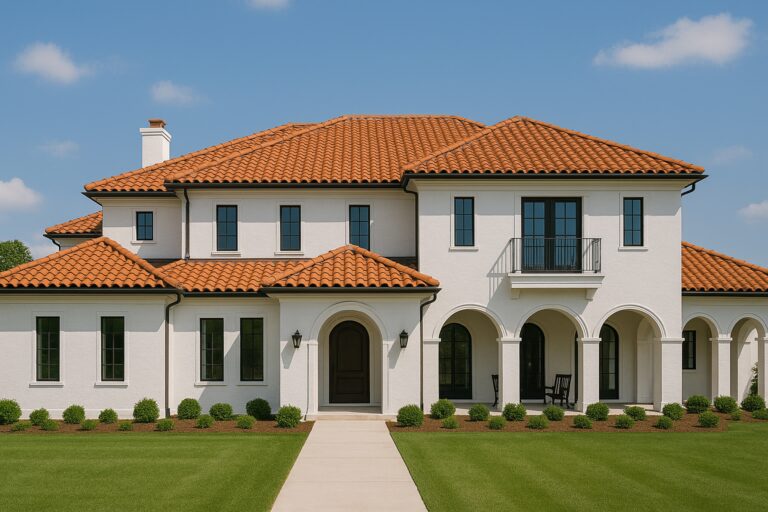
Tile roofs have been used for centuries around the world, a testament to their enduring advantages. Here are some of the key benefits that make clay or concrete tile roofing a great option for homeowners.
Tile roofs are known to last a very long time. A properly installed clay tile roof can last 50 to 100 years, and concrete tiles can span 30 to 50 years. In fact, it’s even common for tile roofs to outlive the very homes they cover.
Clay and concrete tiles are non-combustible. They do not burn, which gives them a Class A fire rating, the highest given.
Tile roofs are designed to withstand extreme weather events. Tiles are heavy and securely attached to the decking, so a well-installed tile roof can resist high winds up to 175 mph. Tile also stands up well to intense heat and UV exposure – the color of clay tile is baked into the stone and doesn’t fade over time. Additionally, tile’s curved shape and durable material can easily handle heavy rains by quickly channeling water off the roof. Tile is impervious to insect damage and rot. In hail storms, large hail (+4″) can crack tiles, but individual damaged tiles can be replaced easily.
Tile roofing can contribute to a more energy-efficient home. The mass of clay or concrete tiles has a natural thermal resistance that helps regulate indoor temperatures. Tiles absorb heat during the day and release it slowly, which can keep your home cooler in the daytime and warmer at night. Moreover, the curved shape of many tiles creates an insulating air gap between the tiles and the roof deck. This airflow under the tiles helps vent heat away in summer. Many homeowners find that tile roofs help reduce their cooling costs in hot climates. Some modern concrete tiles also come in “cool roof” colors that are engineered to reflect more sunlight.
Once a tile roof is installed, it requires minimal upkeep. The tiles themselves need very little maintenance—they won’t warp or corrode. In many cases, the most you might need to do is remove debris like leaves or dirt that accumulate in valleys or clean off any moss or algae in wetter climates (and even that is often cosmetic). The underlying waterproofing (the underlayment) is what usually requires attention after several decades, but the tiles protect it so well that it lasts a long time too. And if a tile does crack or break (for example, from a heavy impact), you can simply replace that tile without having to replace large sections of the roof.
At RISE Roofing, we bring expertise in installing and maintaining tile roofing systems. We understand that choosing a tile roof is a significant investment, and we’re here to ensure you reap all the benefits by doing the job right. In this comprehensive overview, we’ll cover the benefits of tile roofing, the different types of tiles available, how the installation process works, what kind of lifespan and durability you can expect, cost factors, and maintenance tips. By the end, you’ll see why a tile roof is often called the last roof you’ll ever need, and how RISE Roofing can make it a reality for your home.
Few roofing options can match the old-world charm and remarkable longevity of tile roofing. Seen on historic homes and modern estates alike, clay and concrete tiles create a distinctive, elegant look while providing outstanding protection for your home. For homeowners who value a roof that not only stands the test of time but also elevates the architectural character of their home, tile roofing is an excellent choice. These roofs have been known to last for decades – even a century or more in the case of high-quality clay tiles – offering a ‘install it and forget it’ peace of mind that is hard to find with other materials.
When opting for a tile roof, you have a few choices in terms of material and style. The two primary types of roofing tiles are clay tiles and concrete tiles.
Clay roofing tiles are made from natural clay that is shaped and then fired in a kiln at high temperatures. This process hardens the clay and can also lock in color (for example, traditional terra cotta clay tiles get their color from the clay itself and the firing process). Clay tiles have been used for millennia – think of the classic red roofs in Spanish or Italian villages. They are known for their longevity; high-quality clay tiles can last well over 100 years. Clay tiles are a premium product and typically cost more than concrete. They are also slightly lighter than concrete tiles, though still quite heavy compared to other roofing materials. Clay tiles often retain their color very well over time (especially true terra cotta that isn’t just surface-painted). They can come in various profiles, such as Spanish (S-shaped) tiles, Mission (half-barrel) tiles that are laid in pairs (one concave, one convex), or flat interlocking clay tiles that emulate wood shake or slate. Clay is a bit more brittle than concrete, so installers need to be careful when walking on them, and homeowners should too during maintenance. But their beauty and longevity are unparalleled.
Concrete tiles are made from a mixture of cement, sand, and water that is molded under high pressure and heat. They can be formed into many shapes and can have pigments added to create a wide range of colors. Concrete tiles became popular as a somewhat more affordable alternative to clay, while still providing a similar appearance and strong durability. A concrete tile roof can easily last 30-50 years or more. Over time, the surface color on concrete can fade a bit (especially if it’s just a surface color coating), but many concrete tiles now have integral color (pigment mixed in) or slurry coatings to keep them looking good for decades. Concrete is slightly heavier than clay on average, so weight consideration is important. Like clay, concrete tiles come in various profiles: you can get Spanish style concrete tiles, flat profile tiles that resemble slate or shake, and other custom shapes. Some concrete tiles are designed to be high-profile (dramatic curves) and others low-profile (flat or small roll). They are durable against impact and weather, though like clay they can crack if hit very hard or if walked on improperly. One advantage of concrete tiles is they offer a broad palette of colors, including darker shades or even blends, which is great for matching specific home color schemes.
These create the classic look of Mediterranean and Spanish Colonial architecture with their rounded barrel shapes. They are often installed in an overlapping pattern of convex and concave pieces, creating beautiful shadow lines.
These can mimic the look of slate or wood shakes and offer a more understated, flat surface (though usually thicker and more dimensional than asphalt shingles). They work well on French, English cottage, or modern style homes where a smoother roof texture is desired.
An S-shaped tile (sometimes called a pantile) has the shape of a gentle wave. Each tile forms a peak and valley (like an S on its side). These interlock and give a similar effect to the mission style but with a single piece. They are common in many tile roofs globally.
Both clay and concrete tiles are excellent, and the right choice may come down to your budget, aesthetic preference, and sometimes local availability. For instance, genuine clay tiles might be chosen for a very high-end project or historically authentic look, whereas concrete tiles might be preferred for a wide selection of colors and a bit of cost savings. RISE Roofing can help you explore samples of each and decide which fits your vision for your home.
Installing a tile roof is a specialized craft. The process is more labor-intensive and intricate than installing asphalt shingles or metal, but when done properly by experienced professionals like our team, the result is a stunning and long-lasting roof. Here’s an overview of how RISE Roofing manages quality throughout a tile roof installation.
Before installation, we ensure that your home’s structure can support the weight of a tile roof. Tile is heavy – often 2-4 times heavier than asphalt shingles per square foot. If you’re replacing a lighter roof with tile, an engineer may need to evaluate your roof trusses or rafters. Sometimes additional bracing or support might be added to meet building codes for the heavier load. Many homes in areas where tile is common are already built to handle it, but we always double-check for safety.
If you have an existing roof (like shingles) it will be removed. We strip the old materials down to the roof deck. We then inspect the deck for any damage or rot and perform necessary repairs. Having a solid deck is crucial since the tile roof will last so long – we want the foundation of the roof (the decking) to last just as long.
One of the most important parts of a tile roof is actually what you don’t see – the underlayment. Because tiles are not sealed at every edge (they overlap and have small gaps under them), the underlayment beneath serves as the primary waterproof barrier. We install a high-quality, felt or synthetic underlayment that is typically heavier grade for tile roofs (often two layers of 30# felt or a special single-layer synthetic designed for tile). In some systems, a self-adhering membrane (peel-and-stick) might be used on the entire deck or just at eaves and valleys for extra protection against any water intrusion. Flashings (metal pieces) are also installed at valleys, roof edges, and protrusions (vents, chimneys) to further waterproof these vulnerable areas. This underlayment and flashing layer is what keeps your roof watertight, while the tiles on top protect the underlayment from the elements and mechanical damage.
Depending on the tile and local practice, we may install wooden or plastic battens – which are narrow strips of material horizontally across the roof – to hang or secure the tiles. Battens can aid in installing certain profiles of tile and also provide that air gap beneath tiles which improves ventilation. Not all tile installations use battens; some tiles can be direct-nailed to the deck. We follow the tile manufacturer’s recommended method and local code requirements.
Now comes the careful placement of each tile. Starting at the lower edge of the roof, we lay out the tiles in courses. The method varies by tile type.
We lay the “pan” tile (concave) and the “cover” tile (convex) alternately. The pan tiles are secured to the roof (often with nails or screws into the battens or deck, sometimes with a dab of mortar or adhesive for extra hold), then cover tiles are placed covering the gap of pan tiles and also secured.
Each tile overlaps the one below and interlocks or aligns with adjacent ones. We nail or screw each tile to the deck or batten. Often one nail per tile is used, in a preformed hole, but high-wind installations might require two or wire tie-downs.
They overlap like shingles. Each tile usually has at least one fastener to hold it to the deck/batten. We stagger the joints like a brick pattern for strength and appearance.
We pay special attention to the alignment and the pattern to ensure the rows are straight and the visual effect is consistent. We also follow precise spacing because tiles will expand a bit with heat and need appropriate gaps to avoid pressure cracking.
At the roof ridges and hip lines (external angles), we use specially made ridge/hip tiles to cap those areas. Traditionally, these might be set in mortar (you might have seen old clay tile roofs with mortar at the ridges). These days, there are also mechanical systems with metal ridge anchors and closure pieces that can hold ridge tiles without a lot of mortar, which allows for better ventilation and easier repair if needed. We ensure the ridge is both secure and looks great, often using tiles that complement or accent the field tiles.
As we approach areas like roof valleys or around chimneys, we custom-cut tiles to fit neatly and make sure the flashing in those areas is properly covered but water flows on top of flashings as intended. For example, in valleys, we may cut tiles so they end a few inches from the center of the valley, leaving the metal valley exposed as a channel for water, or use an underlay method that hides the valley metal. All plumbing vents and other penetrations get special treatment – usually flashing that goes under tiles above and over tiles below, sometimes with small lead or aluminum covers shaped to the tiles.
After all tiles are in place, we carefully check the whole roof. We replace any tiles that may have gotten chipped during installation (tile is sturdy but occasionally a cut edge might break and we swap those out). We ensure all debris is cleared – importantly, any broken tile pieces or nails, etc., are removed from gutters and the site. We then invite you to inspect the work with us. A tile roof is a showpiece on a home, and we want to make sure you’re thrilled with how it looks as well as confident in its performance.
Installing tile is a true blend of craftsmanship and technical skill. Our RISE Roofing installers are experienced in handling tile with care, so your roof isn’t just assembled, it’s crafted. We take pride in installing tile roofs that not only look stunning but are built to deliver their legendary durability.
Both clay and concrete tiles are incredibly durable, but there are some details to point out.
Clay tiles are often cited as having the longest lifespan of common roofing materials. It’s not unusual for well-made clay tiles to last 50-100 years. Some historical buildings around the world still have their original clay tile roofs intact after a century or more. Clay is inherently weather-resistant and does not deteriorate from UV rays. Its color, if natural, goes through the tile so it doesn’t peel or fade drastically. However, individual clay tiles can be somewhat fragile if struck by a heavy impact (like a large branch or severe hail). If you live in an area with frequent large hail, you might get a few broken tiles in a storm – but typically, you would just replace those tiles. The overall roof remains intact. Clay also can handle heat and cold well if it’s a high-quality grade. In regions with freeze-thaw cycles, it’s important to use clay tiles that are rated for freeze-thaw (some cheaper clay tiles might crack if they absorb water and freeze; premium ones are made denser to resist this).
Concrete tiles, while not as time-proven as clay (since they haven’t been around for centuries), still boast a hearty lifespan of 30-50 years or more. Many manufacturers offer long warranties on concrete tiles (50 years is common, sometimes considered a “lifetime” warranty). Concrete tiles may slowly harden over time (concrete cures more as years go by, actually increasing in strength to a point). Their main wear factor is surface weathering – the outer layer might erode slightly or the color might gradually fade over decades. This doesn’t usually affect their water-shedding ability. As with clay, a hard impact can crack a concrete tile, but they tend to be a bit more forgiving than clay (they have some flex before they break).
While the tiles themselves can last a very long time, the underlayment beneath does not last as long – typically 20-30 years for standard felt underlayment, possibly longer (30-40 years) for some high-end synthetic underlayments. Often, a tile roof will require an underlayment replacement mid-way through its life. This involves removing the tiles, replacing the underlayment, and then reinstalling the tiles (reusing the old tiles which are still good). It’s a significant maintenance item but far less expensive than a whole new roof since the tiles (the expensive part) are reused. With newer synthetic underlayments that we use at RISE Roofing, we aim for an underlayment that can match the life of the tiles as much as possible to minimize these large maintenance cycles.
Both clay and concrete tiles have excellent resistance to the elements over time.
They are very heat-resistant and don’t degrade under intense sun. This makes them ideal for hot climates; they don’t dry out or soften like some other materials might.
Water has essentially no effect on the tile itself (water just runs off). As long as the roof is pitched (sloped) correctly for tile and everything is installed well, heavy rains are not an issue. Tiles create natural channels for water to flow to the gutters.
The key for wind is the installation method. Tiles are heavy, but if wind gets under them, they could lift if not secured. In high-wind zones, we use extra fasteners or clips and sometimes foam adhesives to keep each tile firmly attached. Properly installed, tile roofs can meet stringent hurricane wind codes.
As mentioned, tiles are non-combustible. If embers land on the roof, the tiles won’t catch fire. That durability in fire can be critical in wildfire-prone areas. Do ensure that debris (like dry leaves) doesn’t accumulate under tiles or on the roof, as those could ignite even if the tiles themselves do not.
Neither clay nor concrete is appetizing to insects or susceptible to rot. You won’t have to worry about termites or mold damaging the tiles. Sometimes birds might nest under eaves of tile if there are gaps – but we often install bird stops at the eaves (these are special pieces that block the openings under the first row of curved tiles, for instance) to prevent that.
A tile roof, when installed with quality materials and maintained periodically, is one of the longest-lasting roof systems available. Many homeowners love knowing that once their tile roof is on, they likely will never need to replace the roof in their lifetime. That peace of mind, combined with the beauty of tile, truly makes it a premium roofing choice.
It’s no secret that tile roofing comes with a higher price tag compared to more common materials like asphalt shingles. Tile is often regarded as a premium roofing option, but it’s important to view that cost in the context of what you’re getting: extraordinary lifespan, beauty, and low maintenance. Let’s break down some cost considerations.
Expect a tile roof to have a significantly higher initial cost than an asphalt shingle roof. Depending on your region and the specific tiles chosen, a tile roof might cost 2 to 4 times as much as a standard shingle roof for the same home. The cost comes from both the materials and the labor. Clay tiles are usually more expensive than concrete tiles. Also, the installation is labor-intensive, often requiring skilled artisans to properly place and secure each tile. The process takes longer than a shingle roof, which increases labor costs. However, remember that with tile’s longevity, this upfront cost is amortized over many more years.
If your previous roof was lightweight and your home isn’t already built for tile, there may be additional costs to reinforce the roof structure. This could involve adding supports or bracing in the attic. This is a one-time cost that ensures your home can safely carry the heavy load of tiles. RISE Roofing will assess and inform you if any structural work is needed. In many cases, houses in areas where tile is common are pre-built for it, so this might not be a concern.
We use high-quality underlayment, flashings, and potentially battens or other specialized materials for tile roofing. These materials are a bit costlier than those for a basic roof because they need to be durable enough to last a long time under the tiles. For example, a high-grade synthetic underlayment costs more than standard felt but can last much longer, aligning with tile’s lifespan.
While the initial cost is high, consider that you likely will not have to replace your tile roof for 50+ years. Compare that to an asphalt roof that might need replacement 2-3 times in that span. Over decades, a tile roof can actually be cost-competitive when you factor in multiple replacements avoided. Additionally, tile roofs can increase property value – prospective buyers recognize the durability and beauty of a tile roof and often view it as a strong selling point. If you ever sell your home, you may recoup a good portion of the investment.
In some regions, having a tile roof might get you lower home insurance premiums due to its fire resistance and hail durability. It’s worth checking with your insurance. Energy savings (lower cooling costs in hot weather) can also add up over time, indirectly offsetting some of the expense.
Day-to-day maintenance cost for tile is very low. You might occasionally pay to replace a broken tile or two, which is not very expensive (tiles can cost a few dollars each plus labor to swap them). The larger cost down the road might be replacing the underlayment (as discussed, around the 20-30 year mark). That cost is a fraction of a new roof since tiles are re-used, but it is a cost to be aware of. If you use a long-lasting underlayment, you might push this out to 40 years or more. We will give you an idea of what to expect for underlayment service when we plan your roof.
If you’re torn between clay and concrete, cost might be a deciding factor. Concrete tiles generally run cheaper than clay, sometimes by 20-30% or more, depending on style. So if you love the look of tile and the concept of longevity but want to save, concrete is the more budget-friendly tile. Clay, on the other hand, offers the longest life and a very premium appeal, at a premium price. We can provide estimates for both options if you like.
At RISE Roofing, we strive to offer competitive pricing for tile roofing installations, and we can often work out financing plans to make this investment more manageable. We also ensure transparency – we’ll break down the costs for materials, labor, and any extras so you understand where every dollar is going. Our goal is to give you a roof that is worth every penny: one that you absolutely love and have confidence in for the many years to come.
One of the benefits of tile roofs is that they are relatively low maintenance, especially compared to something like wood shakes. However, no roof is completely maintenance-free. Here’s how to take care of your tile roof to ensure it lasts its full potential.
Even though tile roofs last a long time, it’s wise to inspect them annually, or at least every couple of years, ideally by a professional or from the ground with binoculars. What to look for: any cracked or broken tiles, debris accumulation in valleys or against chimneys, or any displaced tiles. Often, tile issues are localized (like one tile cracked by a falling object). Spotting that early means an easy fix.
Leaves, pine needles, or moss (in damp climates) can accumulate on a tile roof, particularly in the valleys or other areas where the roof changes direction. This debris can trap moisture against the roof and, in the case of moss, even grow under tiles and lift them slightly. Periodically clear off debris. This can be done carefully with a leaf blower or by hand. Avoid using high-pressure power washing, as that can damage the surface of the tiles or force water under them. If moss is an issue, there are gentle chemical treatments that can remove moss without harming the tiles (and zinc or copper strips near the ridge can help prevent growth).
Limit foot traffic on a tile roof. Tiles can crack under heavy weight or if stepped on the wrong place. If you need to retrieve something from the roof or clean gutters that require stepping on the roof, it’s best to call a professional who knows how to navigate on tile (stepping on the headlap – the overlapped part – of the tiles, and distributing weight). If you must do it yourself, use extreme caution, wear soft-soled shoes, and try to step where tiles overlap (where it’s supported beneath by another tile or batten). Many tile roofs will have a few broken tiles over time simply from necessary maintenance or someone walking on them—know that those tiles can be replaced.
Keep your gutters and downspouts clean. This is important for any roof, but with tile, if gutters back up, water can overflow and possibly get up under the tiles at the eaves. It’s a good practice to ensure water flows off your roof and away from your home properly.
If you do find a cracked or broken tile, have it replaced promptly. One broken tile isn’t an emergency since there’s underlayment below, but you don’t want to leave any gap open to weather for too long. It’s usually straightforward: the broken tile is removed (often by sliding it out if not mortared or by lifting adjacent ones to free it) and a new matching tile is put in its place, secured appropriately. Keeping a few spare tiles after installation is a good idea for future repairs, as dye lots can change over the years. RISE Roofing often provides a few extras or can source matching ones later if needed.
Over the years, metal flashing or mortar at ridges can develop issues (mortar can crack, metal can pull away slightly or rust if not aluminum/stainless). During an inspection, we check these and maintain as needed. It might involve re-securing or resealing flashings. These are minor repairs but help ensure the roof remains watertight at joints.
Given the longevity of tile, it’s smart to have a professional roofing check-up maybe every 5 years. Our team can come and inspect the roof more closely, including lifting a few tiles to check the underlayment condition. We can give you an idea if any preventative maintenance is needed. For example, after about 20-25 years, we might suggest proactively scheduling an underlayment replacement in a few years if we see signs of wear, so you can budget for it. We also ensure all is well after major events (like a very severe hailstorm or windstorm).
If you plan to add things like solar panels or new skylights on a tile roof, always involve professionals. Tile roofs can be adapted for such features, but it requires care (removing tiles, adding flashing, cutting tiles) that should be done by those familiar with tile. We often coordinate with solar installers, for instance, to ensure mounting brackets are installed with no leaks and tiles are properly replaced around them.
In summary, tile roofs don’t demand a lot of attention, which is part of their appeal. With just periodic monitoring and minimal interventions like cleaning and the occasional tile replacement, your tile roof will protect your home beautifully for generations. And remember, RISE Roofing is here to assist with any maintenance needs. Our team knows tile roofs inside and out, so we can help you keep yours in prime condition.
If you’re considering a tile roof, it’s crucial to have an experienced roofing contractor handle the job. Tile roofing is a significant investment and a specialized craft. Here’s why RISE Roofing is the right choice for installing (or servicing) your clay or concrete tile roof.
Our roofing professionals are trained and experienced in tile roofing. We understand the unique requirements of working with heavy, fragile tiles and how to install them correctly. From knowing how to stagger and secure each piece, to cutting tiles for perfect fitment around roof details, we bring craftsmanship to every tile project. Not all roofing companies handle tile due to its complexity, but RISE Roofing has a proven track record of beautifully completed tile roofs.
We source top-quality clay and concrete tiles from leading manufacturers. We can procure tiles that not only look stunning but have the proven durability and manufacturer warranties to give you peace of mind. Similarly, we use premium underlayments and stainless or galvanized fasteners that resist corrosion. All components of your tile roofing system will be built to last.
Detail matters greatly in tile roofing. Our team is methodical – ensuring courses are straight, tiles are properly overlapped, and that all those little pieces (like ridge trim, hip trim, and bird-stop eave closures) are done neatly and effectively. We treat a tile roof installation like laying a giant puzzle with absolute precision. This attention ensures not just a nice look, but also that your roof performs exceptionally in shedding water and resisting weather intrusion.
We know a tile roof is a big decision. We take the time to explain the process, show you different tile options, and inform you of what’s involved at each step. We’ll keep you updated during the project so you know what’s happening – such as when the underlayment is done, when tiles are going up, etc. After installation, we also educate you on how to care for your roof and what to expect over the coming years, so you feel confident and informed.
RISE Roofing stands by our work. We offer a robust workmanship warranty on all our installations, so if anything isn’t right, we’ll fix it. Additionally, the tile products we install come with strong manufacturer warranties (often 50 years or more). If you ever encounter an issue with a tile or any part of the roof, even years later, you can call us and we’ll be there to help. Our after-service support is just as important to us as the initial installation.
Installing a tile roof can be a noisy, intensive process (with tile cutting, etc.), but we aim to make it as painless as possible. We protect landscaping where needed, keep the worksite tidy, and after the job, ensure your property is clean of any debris (we run magnets for nails from old roofs, clean up all tile fragments, etc.). We strive to leave nothing behind except your gorgeous new roof.
As a local roofing leader, RISE Roofing has built a reputation for excellence and integrity. Many of our tile roofing customers come through referrals from others who loved our work. We are fully licensed and insured, and we comply with all local building codes and standards. When you choose us, you can trust that we will treat your home with the utmost care, as if it were our own.
Clay tile roofing offers unmatched durability, aesthetics, and energy efficiency, especially in hot climates like Houston and Corpus Christi. These roofs can last 50 to 100 years with minimal maintenance and are naturally resistant to fire, mold, and rot. Clay tiles reflect heat, keeping your attic cooler and reducing A/C costs. Their classic appearance also boosts curb appeal and property value.
When properly installed and maintained, a clay tile roof can last 75 to 100 years or more. The tiles themselves are highly durable, and only the underlayment may need replacement every 25–30 years. In Texas, clay tiles resist UV damage, high winds, and rain, making them ideal for long-term performance.
Yes, clay tile is an excellent choice for both inland and coastal Texas homes. It holds up well against intense sun, high humidity, and wind-driven rain. In coastal regions like Corpus Christi, clay tiles outperform other materials due to their resistance to salt corrosion and moisture. RISE Roofing installs systems engineered to meet Texas windstorm codes and TDI compliance.
Modern clay tiles are tested for impact and wind resistance. Many models meet Class 3 or Class 4 impact ratings and can withstand winds up to 150 mph when properly installed. RISE Roofing uses mechanical fasteners, foam adhesives, and edge securement methods that meet or exceed TDI windstorm certification standards. Clay tile systems are among the most resilient roofing types during hurricanes and severe storms.
Clay tiles come in many shapes including Spanish S-curve, flat profile, barrel, and Mediterranean. Color options range from classic terracotta to multi-tone blends, matte finishes, and glazed tiles. We offer selections from leading manufacturers with fade-resistant finishes rated for extreme sun. During your consultation, we’ll show samples and match products to your architectural style and HOA guidelines.
Clay tile is heavier than shingles or metal, averaging 600–1,000 pounds per square (100 sq ft). Most modern homes can support this load, but we always evaluate your roof’s structural integrity before installation. If needed, RISE Roofing will coordinate with an engineer to reinforce rafters or decking. Proper weight support ensures long-term safety and warranty compliance.
Clay tile roofing is a premium system with installation costs typically ranging from $12 to $20 per square foot depending on tile type, complexity, and reinforcement needs. While more expensive upfront, it offers unmatched longevity and energy savings. RISE Roofing provides clear, itemized quotes and offers financing for clay tile projects throughout Houston and Corpus Christi.
Yes, clay tile is a natural, recyclable roofing material. It’s made from earth minerals and contains no chemical preservatives. It promotes passive cooling and reduces urban heat island effects. Its long lifespan also means less material waste over time. RISE Roofing offers sustainable roofing solutions including solar-compatible clay tile installations.
Yes, but it requires special racking and flashing methods to avoid damaging tiles. RISE Roofing works with solar installers to ensure proper tile removal, anchor placement, and waterproof sealing. We can also provide solar-ready tiles or create composite mounting zones during installation. Clay tile roofing and solar panels can work beautifully together with proper planning.
Most clay tile manufacturers offer 50-year to lifetime material warranties. When installed by RISE Roofing, we also include a lifetime workmanship warranty. In hurricane-prone areas, we install systems that meet TDI code so your roof qualifies for full insurance coverage and performance guarantees. Our clay tile projects are built for strength, longevity, and architectural beauty.
We understand your busy schedule, so we make getting a new roof a stress free process.
Over our 10 minute call — we’ll discuss any specific roofing requests, style, and color options. After the call we’ll send you all the information we discussed to assist with any decisions.
In 24-48 hours, we’ll hand deliver or email a free no-obligation price-locked quote.
Click the button below to schedule a call and let’s get started!
Roof Cost Calculator