Commercial PVC Roofing

For certain commercial roofs, particularly those where exposure to harsh chemicals or oils is a concern, PVC roofing stands out as a top-tier choice. PVC (polyvinyl chloride) roofing membranes have been used for decades, offering a proven blend of durability, chemical resistance, and low maintenance. RISE Roofing is well-versed in the installation and upkeep of PVC roofing systems. In this section, we will delve into what PVC roofing is, its benefits, and how it compares to other options. We’ll also highlight why RISE Roofing is the trusted partner for installing a PVC roof that will safeguard your commercial property for the long haul.

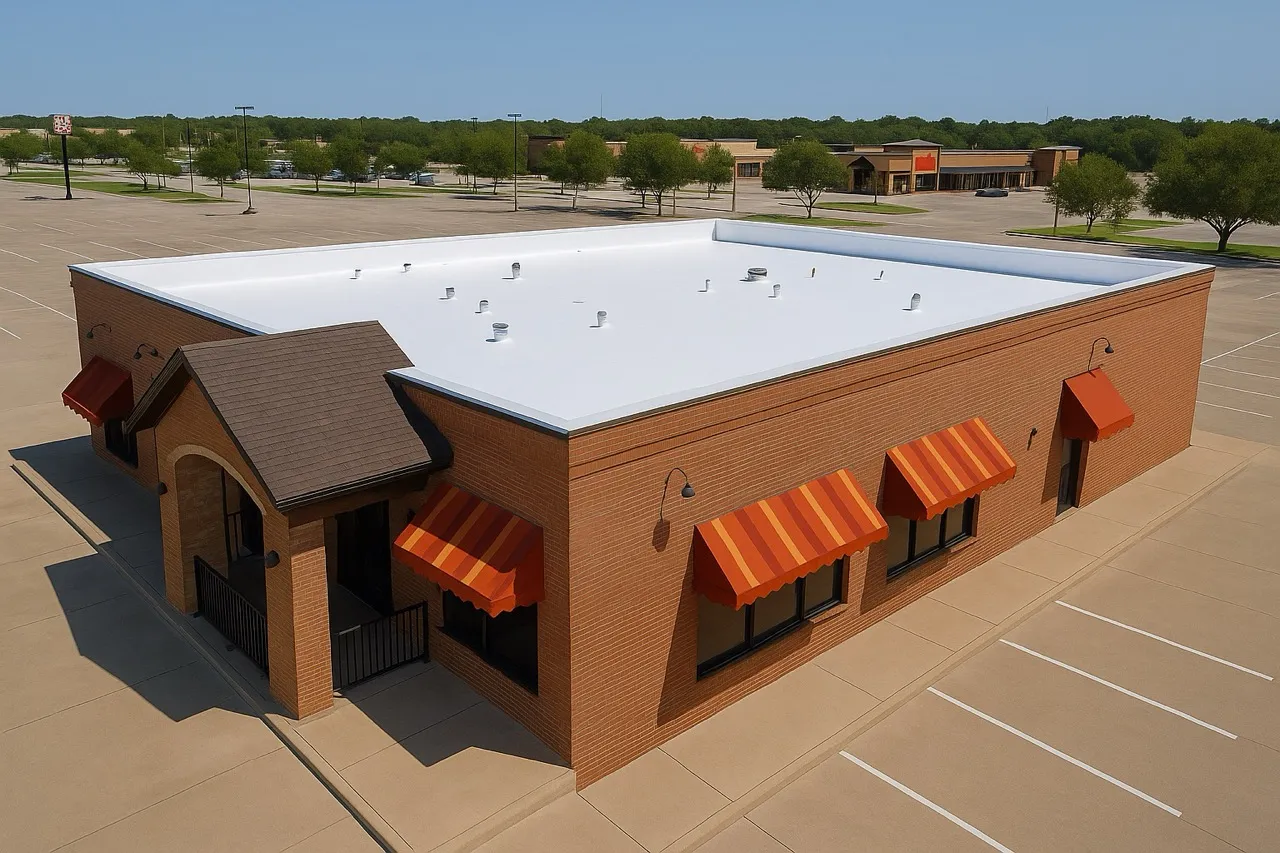
Commercial restaurant in Houston, TX with a new white PVC flat roof installed by RISE Roofing for energy efficiency and durability

In essence, PVC roofing provides a robust, waterproof barrier for flat or low-slope roofs, with the added bonus of excelling in environments that might challenge other materials. It requires proper welding technique and expertise to install (an area where RISE Roofing shines), but once in place, it’s among the most reliable roofing systems on the market.

What is PVC Roofing?

PVC roofing is a single-ply membrane roofing system, similar in concept to TPO or EPDM, but with its own unique material properties.

Material Composition

PVC roofing membranes are made from polyvinyl chloride – a type of plastic – combined with plasticizer additives that make it flexible. They also typically contain a reinforcement (often a polyester or fiberglass mesh) to give them extra strength and dimensional stability. The membrane comes in rolls (common thicknesses are 50 mil, 60 mil, 80 mil, etc.). PVC is usually produced in light colors (white, grey, tan), with white being common for its reflective qualities.

Installation

PVC, like TPO, is usually installed by either mechanical attachment (fastening it to the deck with screws and plates along the seams) or full adhesion (gluing it down with special adhesive), or sometimes ballast. The seams of PVC sheets are sealed by heat-welding, using hot air tools to fuse the material together at overlaps. This creates a permanent bond at seams, essentially making multiple sheets into one continuous membrane across the roof.

Properties

PVC is known for being very fire-resistant (it has a self-extinguishing quality – if a flame source is removed, PVC will stop burning). It’s also inherently resistant to many chemicals, acids, and greases, which is one of its standout features. PVC membranes remain flexible in cold temperatures and are very UV stable, meaning they can handle years of sun exposure with minimal degradation. The material has a track record going back to the 1960s, especially in Europe, and many early PVC roofs are still performing.

Weight

PVC roofing is light, about the same weight range as TPO per square foot. This puts minimal stress on the building structure, making it suitable for a wide range of roofs including those that might not support heavier built-up roofing. It’s often used in reroof projects because you can install PVC over an old roof (with some separation layer) without significantly increasing load.

Environmental Considerations

PVC is a plastic and does involve chlorine in its production (unlike TPO). Some folks raise concerns about environmental impact. However, many PVC manufacturers have recycling programs – trimmings from jobs can be recycled, and old PVC roofs can sometimes be reprocessed into new membranes or other products. PVC’s long life (20+ years common, with many reaching 30+ years) also means less frequent replacement and waste. Its energy efficiency due to reflectivity contributes to lower building energy use. So while the production is more chemical-heavy, its in-use benefits are significant.

Colors & Thickness

While white is common, PVC membranes are available in a variety of colors if aesthetics matter (some buildings might use a grey PVC if they don’t want the bright white look). As for thickness, thicker membranes cost more but offer more durability, especially important in high-traffic areas or where the roof might encounter physical stress. We often recommend a 60 or 80 mil PVC for commercial applications where longevity is desired.

Benefits of a PVC Roofing System

PVC wouldn’t have stayed in use for so long if it didn’t offer distinct advantages. Here are some key benefits of PVC roofing systems.

PVC is highly resistant to chemicals, acids, solvents, and fats/greases. This makes it the go-to roofing material for certain industries. For instance, restaurants or food processing plants often choose PVC because the grease from kitchen vents can degrade other roofing types (TPO, for example, can be broken down by long-term exposure to fats/oils). Similarly, airports (jet fuel residue), manufacturing facilities (chemical emissions), or laboratories might opt for PVC to ensure the roof isn’t compromised by any chemical exhaust or spills.

PVC roofs are among the longest-lasting single-ply roofs. It’s not uncommon for a well-installed PVC roof to last 25-30 years or more with proper maintenance. The material is tough – it resists impact damage and tearing quite well. It also doesn’t get brittle with age in the way some other plastics might; the formulations used in modern PVC keep it pliable for many years. Additionally, the welded seams of PVC are very strong – often stronger than the field membrane itself.

Just like TPO, PVC’s heat-welded seams create a near monolithic sheet across the roof. This means you have excellent protection against leaks – water isn’t sneaking through properly welded seams. And because PVC has been weldable for decades, the technology and methods are well-refined, making those seams very reliable when done by a skilled installer.

PVC membranes have superior fire resistance. Many PVC roofing products have a Class A fire rating when installed in a proper assembly – the highest rating for fire resistance. They are hard to ignite, and as mentioned, tend to self-extinguish. This can enhance the overall fire safety of the building, possibly even contributing to insurance benefits for lower fire risk.

Most PVC membranes are white or light-colored and highly reflective. They meet cool roof requirements set by energy codes or green building standards. By reflecting sunlight, a PVC roof helps keep the building’s roof surface and interior cooler, which can translate into noticeable energy savings for cooling, similar to TPO. Some PVC membranes also have high emissivity, meaning they release heat efficiently. So, they don’t trap much heat.

PVC roofs require little in the way of regular maintenance. They aren’t prone to algae growth due to their smooth surface and chemical composition. They don’t need periodic coating or resealing of seams. Outside of routine inspections and cleaning off debris, there’s not a lot to do. Over time, if a seam did come loose or a tear happened, repairs are relatively simple via patch welding.

PVC can be installed over a variety of substrates and can handle roof movement well if properly designed (with the right amount of expansion joints or stress relief points for large roofs). It’s also relatively easy to flash details with PVC – there are pre-formed accessories or one can field-fabricate flashings for oddly shaped penetrations. The material’s workability (when heated) allows it to be molded around curbs, pipes, etc., making for secure details.

There’s comfort in knowing that PVC has been used since the mid-20th century on roofs and has thousands upon thousands of success stories. Manufacturers have fine-tuned their formulations to overcome earlier issues (like some very old PVC roofs had plasticizer loss problems, leading to shrinkage; modern PVC tech has largely solved this). When you choose PVC, you’re choosing a path well-trodden and documented in the roofing world.

Given these benefits, PVC is often considered a “premium” single-ply roof. It usually comes with a slightly higher price tag than TPO, but many businesses find that the extra upfront cost is justified by PVC’s performance, especially if their building conditions demand it.

Ideal Applications for PVC Roofing

While PVC can be used on practically any flat or low-slope commercial roof, there are particular situations where it truly shines.

As noted, grease exhaust is a common reason to prefer PVC. The roof around kitchen vents can accumulate grease film over time. PVC can withstand this without deteriorating. So, restaurants, commercial kitchens, food processing plants, and the like often use PVC for their flat roof areas.

These facilities may have exposure to fuels or de-icing solutions. PVC’s chemical resistance again is valuable. Plus, large open roofs at airports (think terminals or hangars) benefit from PVC’s longevity and welded seams, providing a long-lasting solution that can handle the expansive footprint.

Facilities that vent out chemicals, manufacturing byproducts, or even high-temperature exhaust (like foundries) might choose PVC. Also, some industrial processes release acidic components (like acid vapor from plating operations) that could settle on the roof – PVC handles such exposure better than most materials.

Any facility where the air being exhausted could carry solvents, acids (e.g., labs with fume hoods), or other chemical traces is a candidate for PVC. Hospitals sometimes prefer PVC for its fire resistance and also because of any potential chemical cleaning agents or medical gases being vented.

If a roof is going to have a lot of maintenance traffic (e.g., a roof with many pieces of equipment that need servicing), PVC’s puncture resistance and seam strength can be beneficial. Additionally, walk pads can be heat-welded to PVC easily to create durable pathways.

PVC’s flexibility in cold weather and performance in hot weather make it a good all-weather membrane. In extremely cold areas, PVC won’t shatter or crack; in hot areas, it won’t soften or bleed. Its ability to handle thermal movement means in places with big temperature swings, it’s a solid choice (assuming installed appropriately).

Sometimes PVC is used as the waterproofing layer beneath a green roof (roof with plants) because of its robust waterproofing and root resistance (with proper type). Some PVCs are formulated to resist penetration by roots and microbes, making them suitable under a vegetative roof assembly.

If you own a building and plan to hold onto it for a long time or if you’re building with a “forever” mindset, the longer lifespan of PVC can be a factor. For owners wanting to minimize life-cycle costs and replacements, investing in PVC could reduce headaches 20 years down the line.

Of course, PVC can also be used in general office buildings, retail stores, schools, etc., even if none of the above special factors apply. It’s a versatile roofing membrane. At RISE Roofing, we’ve installed PVC on a wide array of buildings. In some cases, even if a building doesn’t need PVC’s special resistance properties, the owner might choose it just for its track record and durability. We will assess your building’s needs and help determine if PVC is the best fit or if another system might be more cost-effective without sacrificing performance for your scenario.

How to Choose: PVC or TPO

Since TPO and PVC are similar in many respects (both are white single-ply thermoplastic membranes with welded seams), clients often ask which is better. The answer depends on specific needs.

As discussed, PVC wins here. If chemical exposure or grease is expected, PVC is the safer bet. TPO has improved over the years, but it’s generally not recommended for heavy grease (like around restaurant vents). If your roof will see such conditions, lean towards PVC.

TPO generally comes in at a lower cost than PVC, sometimes by 10-20% depending on brand and thickness. If budget is tight and the environment is fairly clean (no unusual chemical exposure), TPO can be a very attractive option, offering similar general performance in terms of waterproofing and reflectivity. Many building owners choose TPO mainly for the cost advantage if their conditions don’t necessitate PVC.

Both can be long-lived, but PVC has a longer proven track record. Some industry folks might say PVC edges out TPO in longevity, but since TPO hasn’t been around as many decades as PVC, some of that is perception. Quality TPO roofs can last 20+ years; PVC roofs can last 25+ years. It also depends on thickness: a 60 mil TPO vs a 60 mil PVC are both robust; an 80 mil TPO might outlast a 50 mil PVC, etc.

PVC tends to remain more flexible in cold weather than TPO. Early TPO formulations had some issues with becoming brittle in cold or cracking after exposure; current TPO products are much better now. But PVC has the edge in long-term flexibility retention. If your roof sees movement (expansion, contraction, building settling, etc.), PVC might tolerate that a bit better.

Both offer colors beyond white, but TPO’s palette is usually more limited (white, grey, tan are common). PVC sometimes has more options and some manufacturers even offer custom colors for PVC if needed. If a specific color or look (say a blue roof for a school) is desired, PVC might be the route.

Both are welded with hot air. Installers often find PVC a bit easier to weld consistently; it has a broader temperature window for successful welding. TPO can be a bit finicky – too hot and you burn it, too cool and it doesn’t weld. That said, skilled crews like ours can weld either just fine. But from an installation reliability perspective, some say PVC is a tad more forgiving.

If being “chlorine-free” matters to an organization (some environmentally conscious groups prefer not to use PVC due to chlorine content), they might lean towards TPO, which is chlorine-free. Conversely, if having a proven roof is more important than theoretical environmental concerns, PVC’s track record might win.

Some manufacturers only make TPO or only PVC or both. Depending on the brand preferences or warranty offerings, that could sway a decision. For instance, a manufacturer might offer a longer warranty or special deal on one vs the other at a given time.

In many cases, if none of the special concerns apply (chemicals, etc.), we present PVC and TPO as two options to the client. If the price difference is small, some might choose PVC for peace of mind. If it’s larger, they might choose TPO for value. RISE Roofing will install either with the same high quality. We have no inherent bias – it’s about what’s best for the client. We ensure to explain the pros/cons clearly (much like above) so you can make the choice that suits your situation.

PVC Roof Installation Process

RISE Roofing’s approach to installing PVC roofing is thorough and detail-oriented, ensuring that you get the full performance the system can offer.

We maintain certifications with leading PVC membrane manufacturers (such as Sika Sarnafil, Duro-Last, FiberTite, Carlisle, etc.). This means our team has been trained on those specific products and our installations can qualify for their higher-end warranties. Our crew knows the nuances between, say, welding Sarnafil vs. Carlisle PVC (slightly different techniques or tools). This expertise ensures your PVC roof is installed by the book.

We use top-of-the-line automatic welders and hand welders with PVC. These machines are calibrated for the material thickness and ambient conditions (temperature, wind). We also use generator setups that provide consistent power so our welders don’t fluctuate (voltage drops can affect weld temperature). All this is to say: we invest in the gear that makes PVC installation reliable and efficient. We also have the specialized tools for detail work – rollers, silicon pressure rollers, sheet cutters, etc., to get nice clean welds and cuts.

PVC can be installed over various substrates (insulation boards, cover boards, existing smooth roofs, etc.). We take care to ensure the surface is clean and smooth before membrane goes down. Debris or imperfections under the membrane can potentially cause issues (either puncture from below or visible unevenness). So, we’ll vacuum or sweep the deck, and if going over an old roof, we might put down a fleece or separator sheet first.

One hallmark of our installs is the quality of our flashing work. When we seal around things like roof drains, pipes, or corners, we use either manufacturer pre-fabricated accessories or we expertly fabricate pieces on site. For example, for a square roof curb, we might field-fabricate four PVC corners (or use pre-made ones) and weld them in to make a leak-free wrap. We ensure PVC flashing goes sufficiently high up any walls or penetrations to exceed any potential water levels (and meet code). Those transitions from horizontal to vertical are double-checked for solid welds and good fit.

As we weld seams, our crew systematically checks them. We do the “thumb test” or probe test – running a tool along the seam to find any spot that didn’t weld perfectly. If found, we immediately reweld or patch it. We often cut test strips from scrap to dial in the welding machine settings at the start of each day (since morning cool and midday heat can vary). If using adhesives (for adhered systems), we ensure proper coverage and open time so that the membrane really sticks – we don’t want any billowing or loose spots.

At certain critical spots, we apply additional layers of material (called “target patches” or reinforcement strips). For example, at T-joints (where three sheets of membrane intersect), we often weld a small patch over the joint to ensure the stepped layers are fully covered – this prevents any tiny fishmouth or gaps at the seam step. We also reinforce around drains or scuppers for extra protection. Essentially, anywhere that sees extra stress or complexity, we add a bit of extra PVC or manufacture-provided reinforcements to beef it up.

Welding PVC involves hot air and sometimes solvents (if using cleaning agents or primer in some cases). We ensure our crew’s safety with proper gloves, ventilation if needed, and fall protection on the roof. A safe crew works better and more attentively, which yields better quality. Plus we maintain a clean environment – no loose materials that could catch fire (rare with heat guns, but we still be cautious), and organized tools so nothing is accidentally left under the membrane or forgotten.

After installation, a thorough inspection is done by our supervisor and, if it’s a manufacturer-warrantied job, by the manufacturer’s tech representative as well. They will inspect seams, flashings, and details. We’re proud that our roofs consistently pass inspections with praise. Any tiny detail the rep might suggest improving (they have eagle eyes) we handle on the spot. This third-party sign-off can give you added assurance that the roof was done right.

Our professional approach means your PVC roof will perform as advertised – watertight and durable. We treat installation not just as a job to finish, but as a system to craft. And because PVC is a premium material, we make sure the installation lives up to that standard.

PVC Roofing Maintenance Tips

Owning a PVC roof is relatively worry-free, but to maximize its lifespan and benefits, some maintenance considerations apply.

Have the roof inspected at least once a year (and after major storms). Even though PVC is tough, the inspection can catch any developing issues like a loose flashing or accumulated debris. We’ll check seams (though issues are rare if originally well welded), look for any surface damage, and ensure the drainage is clear. Inspections also help maintain warranties.

Over time, a PVC roof can get dirty, especially in pollution-heavy areas or under trees. Dirt doesn’t typically harm the membrane, but it can reduce reflectivity. Cleaning a PVC membrane every few years can keep it bright (using a low-pressure wash or gentle scrub with a non-abrasive cleaner). We have to ensure any cleaning method doesn’t use harsh solvents not suited for PVC. Usually, soap and water or a mild cleaner suffice.

PVC can tolerate ponding water better than some roofs (it won’t degrade just from water sitting). However, it’s still a best practice to address ponding if possible, as standing water can collect dirt or magnify UV. During maintenance, if we see ponding, we might recommend solutions like adding a drain or slight tapered insulation in a future rework. But minor puddles typically aren’t urgent on a PVC as they might be on a less water-resistant roof.

If the roof ever gets a cut or hole (say from a dropped tool or flying debris), it’s usually straightforward to fix. A patch of new PVC can be welded over the area. Even years after installation, PVC remains weldable (one can clean it and weld new material onto old, within reason). It’s one advantage of thermoplastics – they can be repaired by essentially melting on a patch. Our team can do these repairs and we color-match the PVC if possible so the patch doesn’t stand out much.

Very old PVC roofs (30+ years) sometimes suffer from plasticizer migration which can make them a bit brittle or shrink. Modern PVC is better, but eventually, decades down the line, some stiffening could occur. If we notice the membrane getting less flexible as it ages, we’ll keep a closer eye on seams and any tension points. Still, this is far out and doesn’t usually appear until near the end of a very long service life.

If your PVC roof has any accessories like walkway pads, those should be checked that they’re still fully adhered. Also, pipe boots (the seals around pipes) might have a stainless steel clamp – checking those clamps are tight is wise (they sometimes loosen if the rubber in the boot compresses). These are minor things but part of a comprehensive maintenance check.

If your roof has a warranty (e.g., a 20-year manufacturer warranty), that usually requires some maintenance documentation. RISE Roofing can provide scheduled maintenance and keep records to ensure your warranty remains valid. We also know what cleaning or repair methods are acceptable under the warranty to not inadvertently void it.

As the PVC roof reaches the end of its useful life, you might see more frequent repairs being needed, or perhaps some persistent leak that indicates the material is aging out (could be due to years of UV causing some surface crazing or something). At that point (which could be 25+ years in), we’ll help you evaluate whether restoration or replacement is more economical. Sometimes a PVC roof can be coated with a re-roof coating to extend life a bit, or a new PVC layer can be installed over the old (if it’s still well attached, using it as a substrate). We’ll guide you through options when the time comes.

Overall, PVC roofs don’t demand much, especially in the early to mid life. By partnering with RISE Roofing for periodic maintenance, you can essentially set a schedule and not think about it in between – we’ll handle keeping your roof in top shape. And you’ll reap the benefits of one of the most durable roofing systems out there.

Why Choose RISE Roofing for PVC Roofing

Selecting RISE Roofing for your PVC roofing project means gaining a partner who is deeply familiar with the intricacies of these systems and is dedicated to delivering superior results.

We have installed and serviced PVC roofs on a wide array of facilities. Our portfolio includes everything from restaurants and malls to industrial buildings with PVC. This experience means we’re prepared for any challenges and can work efficiently. We’ve likely seen a roof similar to yours and know the best practices for it.

Our goal is to get it right the first time, but we also stand behind our work. If any issue arises, even minor, we address it promptly. Our reputation is built on trust and long-term client relationships, so we ensure that you’re satisfied not just on installation day, but years later. We often take “after” photos and keep them on file for our records and yours – this helps in tracking the roof condition over time.

Not sure if PVC is what you need? We’ll consult with you, inspect your roof or plans, and give honest recommendations. If your building doesn’t actually need PVC and could save money with another system, we’ll tell you that. We’re not about upselling; we’re about right-selling – providing the appropriate solution that will make you happy in the long run. And if PVC is the right choice, we’ll explain why and ensure you feel confident in that decision.

Our crews are not only skilled, they are respectful and follow safety and site protocols. We know we’re often working at a business location where your employees or customers might be around. We aim to minimize disruption, barricade our work area for safety, and keep noise and odors to a minimum. Welding PVC has some smell (heated plastic) but it dissipates; we are mindful of intake vents and will coordinate to avoid nuisance. At the end of each workday, we secure and tidy up the site as much as possible so you’re not dealing with a mess.

With RISE Roofing, you get end-to-end service. Need insulation upgraded under the PVC? We do that. Need new drains installed or old ones refurbished to go with the new roof? We handle it. Looking to add a slight slope with tapered insulation so water moves better? We can engineer and install that as part of the roofing job. Our holistic approach ensures all components work together. Plus, after the installation, we can continue with maintenance as noted. We want to be your go-to roofing resource for the life of your building.

Because of our certified status with PVC manufacturers, we can secure excellent warranty terms. For instance, many offer 20-year full system warranties, some even 25-year or longer for thicker membranes. They know if RISE Roofing did it, it’s done right. That manufacturer trust in us extends to your benefit – you get the best warranty coverage available for your roof, adding an extra layer of protection.

From proposal to completion, we keep you in the loop. You’ll know the timeline, the team involved, and any changes that might come up (though we plan thoroughly to minimize changes). If there are any unforeseen issues (like discovering wet insulation under an old roof during tear-off), we communicate immediately and present solutions with clear pricing. No one likes surprises, especially in construction, so we strive for clarity and openness throughout.

At the end of the day, choosing RISE Roofing means choosing quality, reliability, and a smooth customer experience. We take pride in our work, and that shows in the roofs we install and the satisfaction of our clients.

When you need a roof that can handle tough conditions, last for decades, and give you peace of mind, a PVC roofing system installed by RISE Roofing is an excellent choice. We pair a top-tier material with top-tier service.

PVC Roofing FAQ

What is PVC roofing and how is it different from TPO or EPDM?

PVC (Polyvinyl Chloride) roofing is a single-ply membrane used on commercial flat or low-slope roofs. Unlike TPO or EPDM, PVC includes plasticizers for flexibility and welded seams for superior waterproofing. It resists chemicals, grease, fire, and UV rays, making it ideal for restaurants, factories, and facilities with rooftop exhausts. In Texas cities like Houston and Corpus Christi, PVC holds up well under sun exposure and storm activity, offering durability and energy efficiency.

How long does a PVC roof last in Texas weather?

PVC roofing typically lasts 20 to 30 years, even in harsh climates like Houston and coastal Corpus Christi. The membrane is reinforced and UV-resistant, preventing cracking or breakdown from heat. RISE Roofing installs PVC systems that include warranties of up to 30 years when using high-quality membranes and welds. Annual inspections and prompt repairs can maximize lifespan and maintain warranty coverage.

Is PVC roofing energy-efficient?

Yes. PVC roofing is naturally white and highly reflective, reducing solar heat absorption and cooling loads. It meets or exceeds ENERGY STAR® and Cool Roof Rating Council standards. In hot areas like Houston, it can lower rooftop temperatures by 30% and reduce A/C energy usage significantly. PVC is an excellent choice for building owners seeking a long-lasting, reflective roof.

What types of buildings benefit from PVC roofing?

PVC roofing is ideal for commercial properties including warehouses, shopping centers, industrial plants, and restaurants. Its chemical and grease resistance makes it perfect for food service buildings with rooftop vents. RISE Roofing recommends PVC for buildings with high foot traffic, complex penetrations, or rooftop HVAC systems. It’s durable, flexible, and designed for performance in demanding environments.

How is PVC roofing installed?

PVC membranes can be mechanically attached, fully adhered, or ballasted over the roof substrate. All seams are heat-welded using hot air equipment to create watertight seals that outperform tapes or adhesives. We also install cover boards and insulation layers as needed for code compliance and thermal efficiency. RISE Roofing follows manufacturer specifications to ensure your system qualifies for full warranties.

Does PVC meet windstorm requirements for coastal Texas?

Yes. PVC systems installed by RISE Roofing meet TDI (Texas Department of Insurance) windstorm certification standards. We use mechanically attached or fully adhered systems that can resist high uplift pressures. This is critical for properties in Corpus Christi and Gulf Coast areas prone to hurricanes. Our systems include reinforced edge terminations, perimeter enhancements, and certified fastening patterns.

Is PVC roofing resistant to chemicals and grease?

Absolutely. One of PVC’s biggest advantages is its excellent resistance to grease, oils, chemicals, and acids. This makes it superior to TPO in environments where kitchen exhaust, pollutants, or industrial runoff might contact the membrane. It won’t degrade or soften, even under constant exposure. Restaurants, laboratories, and chemical plants benefit greatly from PVC systems.

How does PVC perform in extreme heat or cold?

PVC is engineered for flexible performance across wide temperature ranges. It doesn’t shrink or crack under the intense heat of Houston summers, nor does it become brittle in cooler seasons. Its heat-welded seams stay strong regardless of temperature swings. It’s a preferred option in climates with thermal cycling, offering reliable waterproofing all year round.

What maintenance does a PVC roof require?

PVC is low-maintenance but benefits from regular inspections and cleaning. We recommend biannual inspections to check welds, flashings, drainage, and surface cleanliness. Debris should be removed and seams resealed if needed. RISE Roofing offers service agreements that include proactive maintenance to preserve warranty coverage and extend service life.

What warranties do you offer for PVC roofing?

RISE Roofing offers PVC systems with 15-, 20-, and 30-year manufacturer warranties depending on membrane thickness and installation method. We’re certified by brands like Elevate and Polyglass, which allows us to offer extended NDL (No Dollar Limit) warranties. We also include a lifetime workmanship warranty to guarantee long-term performance and peace of mind.

Raising Standards, One Roof at a Time

RISE Roofing LLC is a Licensed Registered Texas Roofing Contractor, providing roofing services in Houston, Greater Houston, & Corpus Christi, Texas.