
TPO vs PVC Roofing: The Short Answer
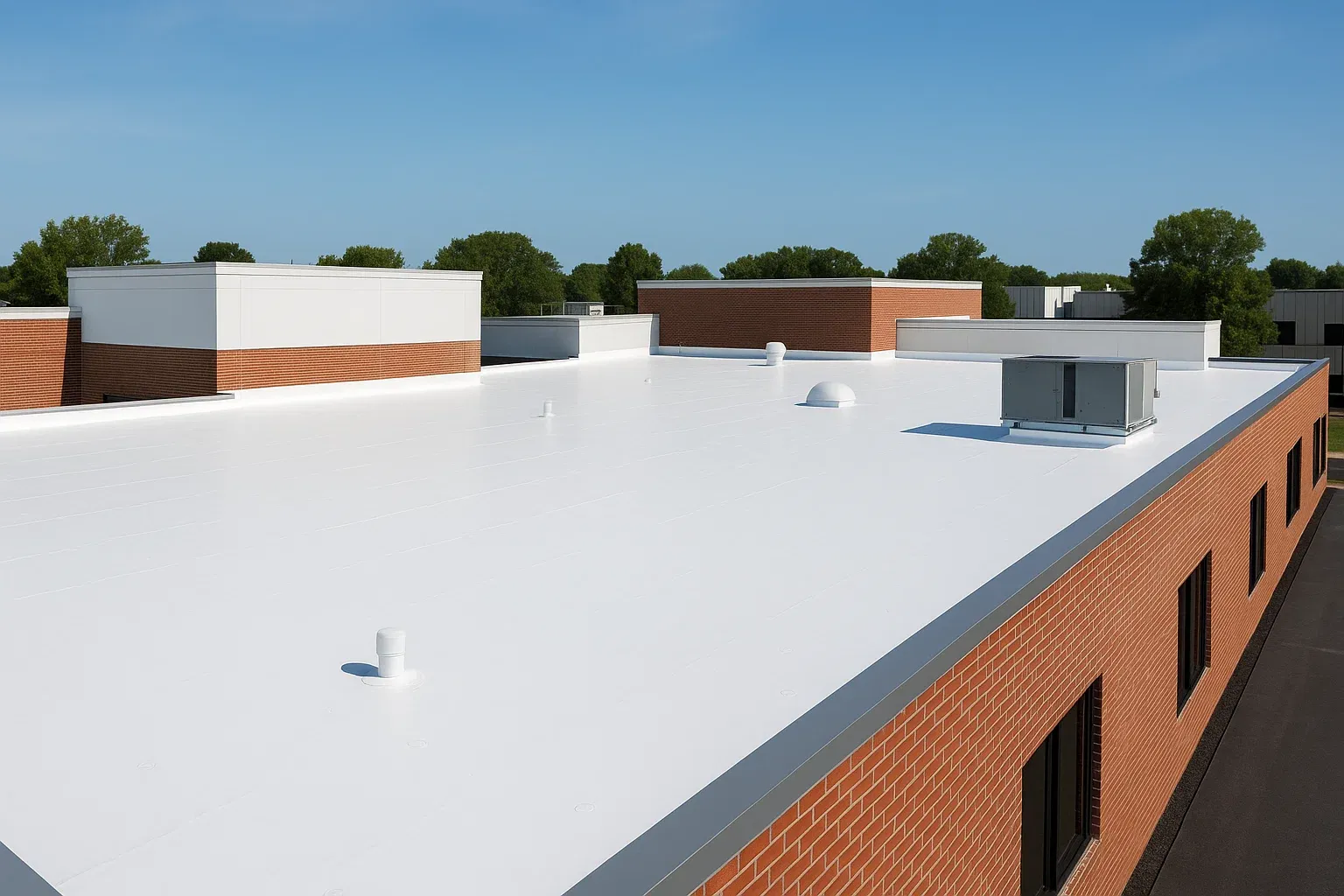
TPO vs PVC roofing comes down to what lands on your roof. Both are white, heat-welded single-ply membranes for flat and low-slope commercial roofs. TPO usually costs less and suits most offices, warehouses and retail buildings. PVC costs more and earns it where grease, oils or chemicals reach the membrane, as on restaurant and food-plant roofs.
The rest of this guide explains why, so you can test any contractor's recommendation against the facts. We are a commercial roofing company on the Texas coast, in Corpus Christi, and we install both membranes. Where our local conditions or our own warranty terms matter, we say so.
What TPO and PVC Have in Common
Both are thermoplastics. The Single Ply Roofing Industry (SPRI) describes TPO (thermoplastic polyolefin) and PVC (polyvinyl chloride) as the two thermoplastic roof membranes, and says both stand up well to UV, tearing, punctures and most chemicals. They are seamed the same way: hot-air welders melt the plastic and pressure joins the sheets.
That shared seam is the main reason owners compare them at all. IBHS describes a welded thermoplastic seam as at least as strong as the membrane around it, and notes that most of these sheets have a polyester or fiberglass layer inside for strength.
They go down in similar ways too. Fastener maker SFS lists mechanical attachment, cold adhesive and induction welding among the methods used for both. And both usually come in white; SPRI says most of each carry Cool Roof Rating Council certification.
The 6 Differences That Matter to a Building Owner
Set the shared traits aside and six differences drive the decision.
1. How the plastic is made flexible
IBHS explains that roofing PVC is made flexible by adding plasticizers. TPO is a different polymer family that does not rely on them, according to SFS, which also argues that plasticizers can break down over time and shorten a membrane's life. The PVC industry answers with a long field record, covered below, so treat this as a question to put to the manufacturer rather than a verdict.
2. Grease and chemical resistance
This is the big one. SPRI singles out PVC's resistance to acids, oils, greases and other rooftop chemicals as excellent, and SFS rates PVC as the more chemical-resistant of the two and the better match for restaurants. If a kitchen exhaust fan or a process vent puts residue on the roof every day, PVC is the safer membrane.
3. Price
Prices for both vary by building, but SFS notes that TPO typically comes out cheaper. On a large roof that gap adds up, which is why TPO is the default where nothing harsh reaches the membrane. Have both priced with the same insulation, attachment, drainage and edge details, or the comparison will mislead you.
4. Track record
PVC has the longer history in roofing. The CFFA, the trade group behind VinylRoofs.org, says PVC has more than 30 years of use in waterproofing. TPO is the newer arrival, which SFS calls relatively new to the market, and IBHS now calls it the most common thermoplastic and the fastest-growing single-ply membrane type.
5. Fire behavior
The CFFA describes PVC as hard to set alight and slow to burn; it says the material does not support combustion and tends to go out on its own when the flame is pulled away. Any single-ply roof, TPO included, has to be part of an assembly that meets the required fire classification, as IBHS points out, so ask for the rating of the full system being bid rather than the sheet alone.
6. Warranty options with your contractor
Warranty terms depend on the product and, often, on whether the contractor is certified by its maker. For us the difference is concrete: RISE is manufacturer-certified for TPO, so a TPO roof from us can be backed for as long as 20 years by the manufacturer's material warranty. On PVC, our proposal names whatever manufacturer coverage the chosen product carries. Whichever you choose, the labor is backed by our 10-year workmanship warranty.
TPO vs PVC Side by Side
| Question | TPO | PVC |
|---|---|---|
| Polymer | Thermoplastic polyolefin | Polyvinyl chloride, made flexible with plasticizers |
| Seams | Hot-air welded | Hot-air welded |
| Usual color | White, other colors available | White, other colors available |
| Oils, greases, chemicals | Resists most chemicals | Excellent resistance, including oils and greases |
| Typical price | Lower | Higher |
| Common fit | Offices, warehouses, retail, apartments | Restaurants, food plants, labs, chemical exposure |
| Warranty options with RISE | Up to 20 years (manufacturer-certified) | The product's own terms |
Energy Use and Reflectivity
On cooling bills, the two are close to a tie. Both are sold mostly in white, and according to the EPA, a cool roof sends less solar heat into the building than a conventional one. Single-ply sheets made with light or cool-colored pigments are one of the agency's examples for low-slope roofs.
SPRI ties TPO's growth to southern climates, where cooling costs outweigh heating costs, and says PVC membranes offer building owners the potential for lower cooling costs as well. So in a hot climate, reflectivity is a reason to choose a white single-ply roof over a dark one, not a reason to choose TPO over PVC or the other way around.
Thinking About Cost Over the Life of the Roof
The bid total is only part of the cost. What you pay per year of service depends on how long the roof lasts and how much upkeep it needs along the way.
That is why the same price gap points in different directions on different buildings. On a warehouse with nothing harsh on the roof, paying more for PVC buys resistance you will never use. On a kitchen roof, a membrane that is less suited to the residue landing on it is likely to need repairs sooner, and the lower price buys fewer good years. Ask each bidder to explain their pick in those terms, not just in price per square foot.
Which Buildings Should Choose TPO
TPO makes sense when the roof's job is to keep water out and reflect heat, with nothing harsh landing on it. Typical cases:
- Warehouses and distribution buildings with wide, open roofs
- Offices and medical offices without kitchen exhaust
- Strip centers whose tenants do not cook on site
- Apartment buildings, schools and churches with small or no kitchen exhaust
On these roofs PVC's extra chemical resistance goes unused, and the money is usually better spent on thicker insulation, tapered drainage or tighter perimeter attachment. Our TPO roofing page covers how we specify it.
Which Buildings Should Choose PVC
- Restaurants, bars with full kitchens and commercial kitchens of any kind
- Seafood, meat and other food processors
- Plants and warehouses with process exhaust or chemical storage near the roof
- Hospitals and labs that vent chemical exhaust through rooftop units
On a shared roof, one tenant who cooks can tip the decision for the whole building. Our PVC roofing page goes into grease containment and drainage on these roofs.
Where EPDM and Modified Bitumen Fit In
TPO and PVC are not the only low-slope choices, and a fair comparison should mention the others. EPDM is a synthetic rubber, a thermoset rather than a thermoplastic. SPRI says its seams are joined with pressure-sensitive tapes instead of welds, and that it is traditionally black, though white is available. Black EPDM absorbs solar heat, which SPRI notes can help with heating costs in northern climates.
Modified bitumen is asphalt modified with a rubber or plastic ingredient and built on a reinforcing layer. IBHS explains that some products are set in hot asphalt and others are torched down, with seams sealed the same way.
Lifespan and Upkeep for Either Membrane
Neither membrane comes with a fixed lifespan. How long a given roof lasts depends more on the installation, the drainage and the upkeep than on which letters are printed on the roll, so compare the manufacturer warranty terms in each written proposal; on the TPO we install, those run up to 20 years.
The routine is much the same for both:
- Keep the surface clean. Dirt cuts reflectance, and the EPA counts periodic cleaning among the upkeep of a low-slope cool roof.
- Keep drains and scuppers clear so water does not stand.
- Put walkway pads on technician routes to prevent cuts and punctures.
- On kitchen roofs, empty the grease catches and clean around exhaust fans on a schedule.
- Have the roof inspected once a year and after major storms, and keep dated photos with the warranty papers.
TPO and PVC on the Texas Coast
Here in Corpus Christi, either membrane faces the same three forces: strong sun, salt air and storm wind. Sun favors a white surface, which both offer. Salt goes after the metal parts of the roof, so corrosion-resistant fasteners and edge metal matter whichever sheet you pick. Wind is resisted by the attachment pattern and the perimeter details, not by the choice between TPO and PVC.
The paperwork is identical as well. Nueces, the county Corpus Christi sits in, is on the state's list of 14 First Tier coastal counties. There, according to TDI, most roof replacements need an inspection and a certificate of compliance, and without that certificate most properties cannot get a TWIA policy. We schedule those inspections on TPO and PVC jobs alike.
Timing matters here too. The National Hurricane Center dates the Atlantic season from June 1 to November 30, so a membrane replaced in late winter or spring has its inspections and certificate wrapped up before storms start forming.
Repair, Coat or Replace an Existing TPO or PVC Roof
If you already have one of these membranes, the question may not be which one to buy. A roof with a few open seams or a torn flashing can be repaired by welding new material over the damage. A roof that is worn but dry underneath may be a coating candidate: a coating can add 10 to 20 years, and as a GAF certified coating contractor we register the GAF Emerald Pledge warranty, with a term of 10 to 20 years tied to coating thickness. See our commercial roof coating page.
Replacement is the answer when water has soaked the insulation or leaks keep moving; our commercial roof replacement page covers that path. Core samples and an infrared moisture scan show which case you are in, and we include both at no charge on buildings over 5,000 square feet as part of a free commercial roof inspection.
How to Settle TPO vs PVC for Your Building
- List what reaches the roof: kitchen exhaust, process vents, chemicals, heavy foot traffic.
- Note how long you plan to own the building and who will pay for the next roof.
- Ask each bidder to price the same insulation, attachment, drainage and edge details.
- Compare the manufacturer warranty and the contractor's workmanship term side by side.
- Ask how the roof will be inspected and maintained once it is on.
If the honest answer to step one is "nothing harsh," TPO is usually the better value. If grease or chemicals show up on that list, PVC usually is.
If two bidders recommend different membranes for the same building, ask each to explain the choice in writing. A good answer points to something specific on your roof, such as an exhaust fan, a drain that ponds or the way a tenant uses the space, rather than a brand preference. If neither thermoplastic feels right, ask about modified bitumen, the asphalt-based option.
Getting TPO vs PVC Roofing Priced in Corpus Christi
If your building is in the Coastal Bend, we can price both membranes from one free inspection. You get a written, price-locked quote, usually within 24 to 48 hours; the offer stands for about 15 days, and the number is locked when you sign. Our commercial roofing hub lists the other systems we install, and you can contact us to schedule a visit.
Frequently Asked Questions
PVC. It resists the oils and greases in kitchen exhaust better than TPO, which is why it is the usual choice wherever cooking residue reaches the roof.
Neither has a set lifespan. Installation, drainage and maintenance matter more than the membrane type, so compare the manufacturer warranty term written into each proposal; the TPO we install carries warranties of up to 20 years.
Often, if the insulation underneath is still dry. A coating can add 10 to 20 years of life. Core samples and an infrared scan show whether a roof qualifies.
Usually not. Both are most often white, and each is also made in other colors. The difference is in the chemistry, not the look.