
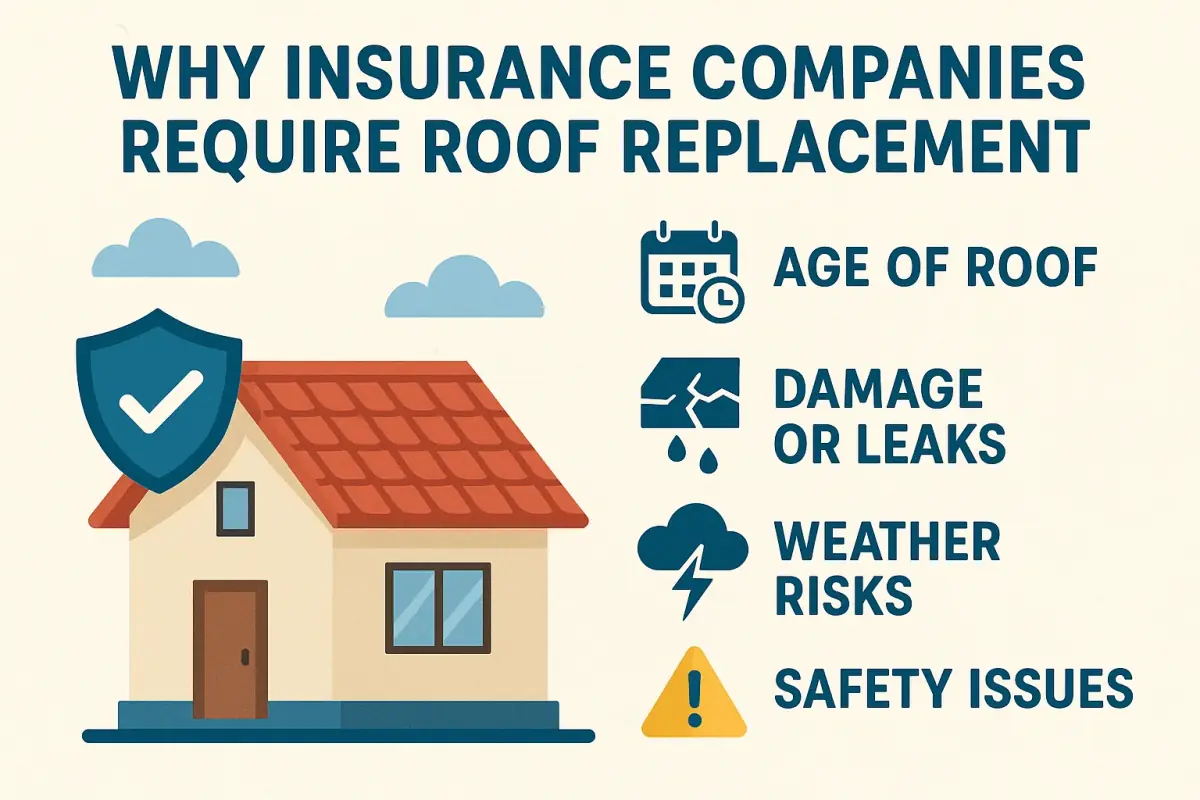
Is your insurance requiring a roof replacement? On the Coastal Bend, that notice can come from either of the two companies that cover most homes here: the carrier that writes your homeowners policy, or the Texas Windstorm Insurance Association (TWIA), which covers wind and hail along the coast. The two follow different rules, send different kinds of letters, and leave you with different options. This guide covers how to tell which one you are dealing with, what each can and cannot do, and how to respond without overspending or letting coverage lapse in the middle of hurricane season.
Insurance Requiring a Roof Replacement? First, Find Out Who Sent the Letter
The Texas Department of Insurance (TDI) points out that home policies written along the coast often leave wind and hail out. Throughout the four-county Coastal Bend, most homeowners fill that gap with a TWIA policy bought through a local agent. So a Corpus Christi or Rockport homeowner can get a roof notice from:
- The homeowners carrier, usually at renewal, often after an exterior inspection or aerial images. The letter may say the policy will not renew, that you must repair or replace the roof first, or that your roof coverage is changing.
- TWIA, usually about the roof's condition or age, or about a past claim that was paid but not documented as repaired.
- Your mortgage company, passing along either of the above. Texas law does not require windstorm insurance, but lenders commonly do, so a lapse can become a loan problem too.
Read the letterhead, the policy number and the deadline. Then call your agent and confirm in plain words: is this a nonrenewal, a condition for renewal, or a change to how the roof will be paid?
Why a Private Carrier May Insist on a New Roof
TDI's guidance says your insurer will inspect your roof when you apply, and that it may charge more or refuse to insure based on what it sees. It also says that, instead of not renewing, a company might require you to repair damage before it renews. Coastal roofs give underwriters plenty to look at:
- Age. Salt air, sun and humidity wear roofs faster here. Locally, architectural shingles run about 25 to 30 years and 3-tab roughly 12 to 18, so a roof that would be middle-aged inland may be near the end here.
- Visible wear. Lifted or missing tabs, bare spots where granules have washed off, and dark algae streaks show up clearly in high-resolution aerial photos.
- Old damage. Storm damage that was never fixed, or a tarp that stayed up too long, reads as an open claim waiting to happen.
- Corroded metal. Rusted flashing, vents and fasteners near the bay or the Gulf suggest leaks are coming.
How TWIA Handles Older or Worn Roofs
TWIA's rules are published, which helps. Three items come up most often for Coastal Bend roofs.
Insurable condition
TWIA requires property to be in insurable condition. Its eligibility criteria list uninsurable physical condition as a reason an application may not be issued.
A paid claim with no proof of repair
TWIA's eligibility page gives a specific example of an uninsurable property: TWIA paid a claim, and a new application arrives without evidence of a new certificate of compliance (WPI-8, WPI-8-E or WPI-8-C) or evidence of repair. If you cashed a windstorm check after a storm and never replaced or properly repaired the roof, expect this to surface. The full list is on TWIA's minimum policy eligibility criteria.
Roofs that move to actual cash value
Under Form TWIA-804, the house stays on replacement cost while TWIA pays the roof covering at actual cash value. TWIA adds it once a roof passes 15 years of age, shows serious wear, or has shingles that are curling, cracking or missing, and TWIA's manual says failing to sign the acknowledgment may leave the property uninsurable through TWIA. That is not a demand to replace, but it is a signal: an older roof will be paid at a depreciated value. Our ACV vs RCV guide shows what that can cost after a storm.
Your Rights When a Notice Arrives
According to TDI's home insurance guide:
- If you ask, a company must tell you in writing why it turned you down or did not renew your policy.
- A company must give advance written notice before it nonrenews; the required notice period depends on when you bought or renewed, and TDI's guide lists the current periods.
- Your company should tell you when it changes your roof coverage, for example by switching an aging roof to actual cash value.
If something seems wrong, TDI runs a consumer help line and accepts complaints. Its insurance and your roof page is a good starting point.
A Response Plan for Coastal Bend Homeowners
- Write down the deadline. Notices give a date by which the work or proof must be done. Everything else is planned backward from it.
- Request the evidence. Ask the company for the photos or report its underwriter relied on. You cannot answer a finding you have not seen.
- Get an independent inspection. A roofer on the roof can tell you whether the problem is the whole roof or a few areas, and photograph both. Sometimes a documented repair satisfies the requirement; sometimes it does not.
- Ask what will satisfy them. Will a repair with photos do? Do they need a replacement, an invoice, a new WPI-8? Get the answer in writing.
- Shop the homeowners policy if needed. Different carriers draw the line on roof age and condition differently. Start early, because a new carrier will inspect too.
- Watch the calendar. TDI notes TWIA will not sell a policy while a hurricane is in the Gulf of Mexico. A nonrenewal that lands in August is far riskier than one that lands in February. Do not let a gap open between June 1 and November 30.
- Send proof before the deadline. Completion photos, the invoice and any certificates should reach your agent with time to spare.
Repair or Replace? A Quick Decision Table
| What the inspection finds | Usually the sensible move |
|---|---|
| Sound roof, a few damaged areas, years of life left | Repair, photograph before and after, send the documentation |
| Roof is past the typical lifespan for its material here | Replace now, on your schedule, rather than after a storm |
| Prior windstorm claim paid, roof never fixed | Repair or replace and obtain the paperwork TWIA asks for |
| Carrier insists on replacement, roof is clearly sound | Ask for the evidence, then compare other carriers before committing |
If You Replace: Do It Once, With the Paperwork
Because Nueces, Aransas, San Patricio and Kleberg counties lie entirely within TDI's catastrophe area, a new roof here generally must be inspected by TDI's windstorm program and receive a WPI-8 before TWIA will continue coverage. A roof that satisfies your homeowners carrier but leaves out the windstorm certificate can solve one problem and create another. Ask any contractor, in writing, who will schedule the inspection. Our Corpus Christi roofing permits guide explains the local steps.
A forced replacement is also a chance to get something back:
- Impact-rated shingles. TWIA's published rating rules give a mandatory credit for UL 2218 rated roof coverings on the dwelling's windstorm premium, with a larger credit for Class 4. Private carriers set their own discounts. Details are in our guide to Class 3 and Class 4 shingle discounts.
- Wind performance. Duration shingles from Owens Corning come with a wind warranty of up to 160 mph as long as the required Owens Corning system parts go on and starter strips line both eaves and rakes.
- A reset clock. A new roof starts over on age-based rules such as TWIA's 15-year actual cash value endorsement.
If the deadline is tight and cash is not ready, qualified homeowners can spread the cost with Acorn Finance, a third-party lender; see roof financing in Portland, Texas for how it works.
Questions to Put to Your Agent Before You Commit
A short phone call with your agent, followed by an email that restates the answers, can save thousands of dollars. Useful questions include:
- Is this notice about the homeowners policy, the TWIA policy, or both?
- Exactly what will satisfy the requirement: a repair with photos, a full replacement, or a new WPI-8?
- If I replace, will the new roof change my premium, my deductible or how a future roof claim is settled?
- Does the carrier credit an impact-rated roof, and which class and paperwork does it accept?
- If the policy is not renewed, how soon should I apply elsewhere so there is no gap during hurricane season?
Mistakes That Make It Worse
- Ignoring the letter. Silence usually ends in nonrenewal.
- Filing a claim to fund the replacement. Wear and age are not storm damage. If there is real storm damage, document it honestly; if there is not, a claim will not change what the roof needs.
- Hiring whoever can start tomorrow. A rushed job without the windstorm inspection can leave you with a new roof and no TWIA eligibility.
- Keeping no copies. Save the notice, every reply, the inspection report, the invoice and the WPI-8 in one folder.
How RISE Roofing Can Help
RISE Roofing offers free roof inspections from Robstown and Annaville to Flour Bluff, North Padre Island, Ingleside, Rockport, Portland and Port Aransas. You receive dated photos of the roof plus a written quote, usually within 24 to 48 hours, which gives you something concrete to hand your agent. If a repair is enough, we will say so. We document conditions; we do not negotiate with insurers or adjusters, and policy decisions stay between you and your carrier.
When a replacement is the right call, we build to the windstorm code and arrange the TDI inspection for the WPI-8. As an Owens Corning certified installer, RISE backs every replacement with a 10-year workmanship warranty. Pricing is locked at signing, and each proposal stays valid for about 15 days, which helps when you are racing an insurer's deadline. Call (361) 204-5325 or request a free inspection. For more signs that a roof is near the end, see signs you need a new roof.